
Tag: C.P. Ramaswami Aiyar Foundation
India: Chennai: Musical morning – Ganesha, the auspicious

The C.P. Ramaswami Aiyar Foundation: The Madras region before the British

C.P. Art Centre: “Celebrating the Leaf”

C.P. Art Centre
Cordially invites you to an exhibition and sale of
Terracottas
By M.S. Raja Arunodhayam, BFA (Sculpture)
Date : July 9 to 16, 2013
Time : 10 am to 7 pm (Open on Sunday)
Venue : Vennirul Art Centre
C.P. Art Centre
1 Eldams Road, Alwarpet
Chennai – 600 018
M.S. Raja Arunodhayam was born in 1972. He graduated from the College of Arts and Crafts, Chennai. He has participated in several exhibitions, including Lalit Kala Acedemy’s Group Show and Victoria Technical Institute, Chennai. His collection of sheet meal is showcased at the SouthZone Cultural Centre, Thanjavur.
Photo: © Arman Zhenikeyev | Dreamstime.com
“A Million Sitas”

Across the stage, the dancer Anita Ratnam engages the sparkling, magical butterfly in conversation, one beautiful day in the woodlands. She trails after the butterfly from branch to branch, and they talk to each other. It turns out that the lovely butterfly is really Manthara. When she appears in her human form in the story of Rama and Sita, Manthara is a quite different, unattractive creature, physically disabled as a hunchback, with a conniving, manipulative personality.
Drawn to Manthara in her form as the innocent butterfly, Anita expresses her understanding of the pain that Manthara must feel in her human form, when she is the brunt of jokes and even has stones thrown at her by village boys.
On Saturday, February 9, 2013, Anita Ratnam gave the complimentary performance “A Million Sitas” at the C.P.R. Centre for the Arts, as part of the Ramayana Festival being held at the C.P. Ramaswami Aiyar Foundation, in Chennai, during the month of February.
One of the outstanding performers of Indian classical dance, Anita Ratnam has a Ph.D in Women’s Studies from the University of Madras, and has had a four-decades long, brilliant career in theatre and television, in the U.S., in India, and in a dozen other countries.
Her dance performances focus on the woman as a pivotal force in Indian myth and legend – and as a vital force in today’s world, no longer to be veiled or suppressed, but to be acknowledged and valued. Myth is central to the process, and Anita calls myth “the deeper truth.”
Sita and Rama are embedded in the Indian consciousness. For five thousand years, every Indian woman has felt an inescapable connection with the role of Sita, who on a straightforward level, is the wife of Rama in the Hindu epic poem, the Ramayana. From the time they are tiny tots, all Indian children, both boys and girls, are surrounded by the enchanting songs and stories of Rama and Sita.
The story of the Ramayana turns on the fate of Sita, who is abducted by the demon Ravana and in the end, after many twists and turns, is rescued by her husband Rama. When they return home, he is crowned king.
Of course, in India, nothing is simple. At the beginning of the story, Sita, portrayed as the obedient, faithful wife, chooses to go with her husband when, through no fault of his own, he is banished into the forest. As well as being a faithful wife, however, Sita is far more than that; she is a strong, dynamic woman, with her own wishes, thoughts, and views. She is very learned and, although quite young, is a scholar. She is an environmental and animal advocate long before there was such a thing, appealing to her husband to give up hunting and to protect and respect the forest animals and their habitat. Ultimately, she is a Goddess, whose true place lies in heaven. She is absolutely central to the Ramayana; without Sita there would be no story.
The performance “A Million Sitas” touches on many of the female roles in the Ramayana. All are intertwined with Sita – she is part of them, and they a part of her.

Usually the character Surpanakha is portrayed as an evil demoness who falls in love with Rama and makes inappropriate advances first to him, then to his brother Lakshmana. Offended by her behavior, Lakshmana attacks her, disfiguring her face, and she flees back to her home in Lanka (Sri Lanka), complaining to her demon brother, Ravana, who then kidnaps Rama’s wife, Sita. In “A Million Sitas,” Anita reveals a radically different view of Surpanakha.
Anita’s dramatic portrayal of Surpanakha, wearing a black cape and an elegant mask, with long painted fingernails, shows us a tribal woman from a matrilineal society. For her there is nothing remotely shameful or inappropriate in the advances she makes to Rama and Lakshmana, which are, in her world, entirely normal and natural. Instead, it is the brothers’ brutal response that is shocking.
In a series of profoundly beautiful dance scenes, allowing the characters to shine in a new light, Anita dismantles the centuries-old patriarchal cast that has grown up around the Ramayana story, showing us the women in the story as they may originally have lived—and revealing the shining hero and Goddess Sita in her myriad forms of “a million Sitas.”

Photos: Sharon St Joan
Top photo: Anita in conversation with the butterfly (as Manthara)
Second photo: Surpanakha
Third photo: Anita Ratnam with Dr. Nanditha Krishna, Honorary Director of the C.P. Ramaswamy Aiyar Foundation
To view the website of Anita Ratnam, click here.
To visit the website of the C.P Ramaswami Aiyar Foundation, click here.
Rama and Sita – history or myth?

The Ramayana, one of the two great epic poems of India is known, not just throughout India, but all of southeast Asia, and to an extent, throughout the world. It has captured the hearts of billions of people over millennia.
Briefly, this is the story of Rama and Sita, who are believed to have lived around 1,000 BC:
One of four brothers, Rama, as the eldest son of King Dasharatha, is about to be proclaimed the crown prince. Before this can happen, one of the wives of Dasharatha, Kaikeyi, demands that her own son, Bharata, be named crown prince instead, and that Rama be sent off to live in the forest for fourteen years. She demands this as her right because, once, many years before, she had saved the life of Dasharatha during a battle. At the time, he promised her two wishes, which she never claimed, and spurred on by her scheming maid, she chooses this moment to claim the two wishes.

Virtually everyone in the city of Ayodhya is aghast at the thought of the beloved Rama, who is adored by all the people, being exiled to the forest. No one is more profoundly distressed than his father Dasharatha, who worships the ground that Rama walks on. Only Rama himself seems unperturbed and calmly accepting of his fate.
Dasharatha is king, and as king he must honor his commitments, whatever the cost. He promised the two boons to his wife, and he must not go back on his word. He has no choice but to grant the two wishes, pledged so many years ago, and to send his beloved son into the forest.
Rama leaves for the forest, accompanied by his loyal brother Lakshmana and his wife, Sita, who has insisted on going with her husband to live in the forest.
After spending over twelve years living in the forest, one day Sita is abducted by the demon, Ravana and is carried off to Sri Lanka, Ravana’s kingdom. Rama, in despair, sets off to find Sita, and is only kept going by the help of his brother, and the many friends he meets along the way, including an army of monkeys and a wise old bear. One of the greatest heroes—perhaps the true hero of the story, Hanuman, is a divine monkey, who exemplifies the qualities of absolute loyalty and selfless devotion to Rama.

With the assistance of so many loyal friends, Rama is able to defeat Ravana and rescue Sita. The two return to Ayodhya triumphant and, with the fourteen years of banishment over, Rama, with Sita at his side, is crowned king, in a happy conclusion.
This is only the barest outline of the story which is infinitely complex, with every character existing on multiple levels, good and bad – divine and human –demonstrating nobility and a higher purpose, as well as human failings and flaws.
The overarching theme of the story is that Rama illustrates the profoundly Indian concept of dharma – or righteousness. Never deviating from his appointed path, he is unfailingly loyal and obedient, first and foremost to his father. It is Rama himself who is determined to obey his father and who never hesitates a moment, following his destiny, to endure a hard life in the forest for fourteen years.
This theme of loyalty, respect for one’s parents, and profound humility has carried through all of Indian culture, throughout the millennia, and is very much alive today in the heart of every Indian.
The story of Rama and Sita, the greatest legend of India, and perhaps the world, was for a long time relegated by western historians to the unhistorical status of myth. One of the extraordinary reasons early European writers gave for this was that James Ussher, an Archbishop of Ireland in the seventeenth century, had calculated, based on the Bible, that the earth itself had been created on October 23, 4004 BC. Consequently, any records, anywhere in the world, which went back before that date must be mistaken. Rama and Sita thus fell into the category of myth, and there they remained until recent years.
During the Ramayana Festival Conference at the C.P. Ramaswami Aiyar Foundation in Chennai, India, February 1-3, it became abundantly clear that the age-old tale is in fact based on history and is not simply mythical.
Indian scholars and authorities are increasingly questioning the assumption by western authorities that the tale is nothing more than a story.
Every event in the story is firmly based on geography, having a precise location that can be pinpointed on a modern map. The Ramayana is filled with lovely descriptions of trees and plants which are all geographically and scientifically precise.
The trees near the kingdom of Ayodhya are those species that are found there today. The trees in the various forests where Rama and Sita lived – and those on the mountain where they met the army of the monkeys are all real, botanically correct trees.

Amazingly enough, though this is quite hard to explain scientifically, there is a mountain in Sri Lanka that is pointed, not rounded like the surrounding mountains. On it grow plants and trees that are found only in the Himalayas, over a thousand miles away.
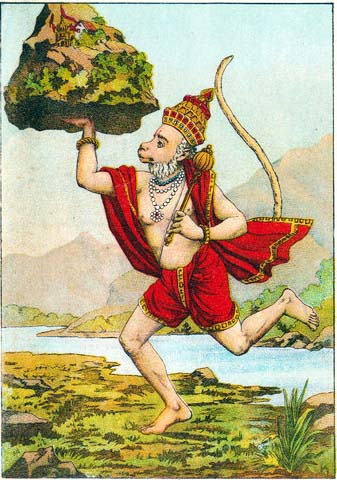
In the Ramayana, Hanuman, the monkey god, is sent off in the midst of a major battle, to bring back an essential herb that is found only in the Himalayas. Hanuman flies through the air, finds the mountain, and then realizes that because he is not a herbalist or a botanist, he has no idea how to recognize the herb he has been sent to get, which is urgently needed to revive Rama’s brother, Lakshmana, who is lying unconscious on the battlefield. All the herbs and plants look alike to Hanuman. Perplexed, he solves the problem, by picking up the entire mountain and flying back to Sri Lanka with it held aloft in one hand.
Lakshmana is given the correct herb and recovers. Whatever all this means, who knows, but the herbs and plants growing on the only pointed mountain in Sri Lanka, grow nowhere else except in the Himalayas.
The tribal peoples of India have many legends about Rama, Sita, and Ravana. The Gond people, for example, have legends that Rama and Sita visited them. These stories are unique to them, and are not found in the standard story of the Ramayana. This means that they have had a separate, native origin. They are not simply derived from the Sanskrit version of Rama’s and Sita’s life. This fact serves to confirm the authenticity of the historical reality of Rama and Sita – since they exist not only in Sanskrit stories, but quite independently – in tribal sources.
The evidence for the historical reality of the lives of Rama and Sita grows only stronger as time passes. Tales and legends from many cultures throughout the world are being found to be not just made up as had for so long been the assumption, but to be based on the actual lives of people and on real history.
Top photo and second photo: Sharon St Joan / Students from the Grove School enacting scenes from the Ramayana.
The Grove School is run by the C.P. Ramaswami Aiyar Foundation and the students took part in the Ramayana Festival.
Third photo: Raja Ravi Press /1920’s / Wikimedia Commons / Public Domain / “The lord Rama portrayed as exile in the forest, accompanied by his wife Sita and brother Lakshmana”
Fourth photo: Raja Ravi Varma (1848–1906) / Original Raja Ravi Verma Lithograph / Wikimedia Commons / Public Domain / Hanuman carrying the mountain from the Himalayas
To visit the website of the C.P. Ramaswami Aiyar Foundation, click here.
N. Vanamamalai Pillai’s “Setu and Rameshwaram”

N. Vanamamalai Pillai’s “Setu and Rameshwaram” is one of three publications to be released at the Ramayana Festival to be held from February 1 – 24, in Chennai, at the C.P Ramawswami Aiyar Foundation.
The Setu is a natural bridge of limestone shoals extending 18 miles from India to Sri Lanka. It was first mentioned in the epic poem, the Ramayana, by Valmiki.
To learn more about the Ramayana Festival 2013, please visit the Ramayana Festival website.
Image: Painting by Raja Ravi Varma (1848-1906) / Wikimedia Commons / “This work is in the public domain in the United States, and those countries with a copyright term of life of the author plus 100 years or less.” / Sri Rama Vanquishing the Sea
Chennai, India: Ramayana Festival in February

By the C.P. Ramaswami Aiyar Foundation
THE RAMAYANA IN LITERATURE, SOCIETY AND THE ARTS
A Festival organized by
The C.P. RAMASWAMI AIYAR FOUNDATION 1, Eldams Road, Alwarpet Chennai 600 018, India. www.cprfoundation.org Tel.: 91-44-2431778, 24337023 e-mail: cprafoundation@gmail.com; ramayanaconference@gmail.com
FEBRUARY 2013
The C.P. RAMASWAMI AIYAR FOUNDATION is celebrating the role of the great epic in the culture of India and South-East Asia.
The Ramayana is a great epic which knows no boundaries of religion or nation. It has taught the values of life and behaviour to men and women over centuries, across India and South-East Asia. There is no finer example in the world of a multi-religious, international culture than the Ramayana. Scores of generations of children have watched performances and narrations of the great epic over 2,000 years, to learn the importance of an ethical life. This has been the cornerstone of the life of India and South-East Asia. Many kings in these countries have taken the name of Rama, cities and islands have been named after persons and places in the epic and symbols of Vishnu (whose incarnation is Rama) have been royal emblems across the region.
The story of the Ramayana is enacted more often than any other story of the world. It is performed by Hindus, Buddhists and Muslims. It is the most important cultural tradition of Thailand, Cambodia, Indonesia, Laos, Myanmar, Nepal and India. It has also been widely prevalent in Singapore, Malaysia and Vietnam. The Ramayana is the great bond of culture which unites India and the countries of South East Asia.
FEBRUARY 1, 2013, at 10 a.m.– INAUGURATION by His Holiness SWAMI DAYANANDA SARASWATHI.
Dr. SUBRAMANIAMSWAMY presides.
Release of the following publications:
1 VALMIKI RAMAYANA by late Justice N. Chandrasekhara Aiyer.
2 THESETU AND RAMESHWARAM by late Shri N.Vanamamalai Pillai.

VENUE for all programmes – The C.P. RAMASWAMI AIYAR FOUNDATION, 1 ELDAMS ROAD, ALWARPET, CHENNAI 600018.
PROGRAMME
FEBRUARY 1 to 24 – Exhibition of the RAMAYANA in PAINTING, SCULPTURE
and POPULAR CULTURE
organised by C.P. ART CENTRE

The Ramayana as it has been created in early 20th century oleographs, miniature and folk painting, bronzes, terracotta and popular toys will be on display. A map of India with Rama’s route from Ayodhya to Lanka and scenes of the various events that took place in each site will be depicted by clay toys.
There will be performances of the RAMAYANA in HARIKATHA, MUSIC and DANCE during this period. The final programme will be posted later.
FEBRUARY 1 and 2 – International Conference on the RAMAYANA in LITERATURE, SOCIETY and the ARTS organised by C. P. R. INSTITUTE OF INDOLOGICAL RESEARCH.
All conference participants should be registered. While there is no participation fee, we are limiting the number of participants, so please register as soon as possible.
FEBRUARY 1 & 2, 2013 – RAMAYANA CONFERENCE
SPEAKERS (in alphabetical order) –
1. Tracing the Antiquity of the Ramayana – Through the Inscriptions, literature and
Art of the Gupta …..Dr. Ashvini Agarwal
2. Plant Diversity in the Valmiki Ramayana…..M. Amirthalingam and Dr. P. Sudhakar
3. The Influence of Ramayana on Kalidasa…..Dr. S. Annapurna
4. Ethical Values of Ramayana…..Dr. V. Balambal
5. Time-honored Depictions of Ramayana in Vidarbha (Maharashtra) during Vakatakas…..Kanchana Bhaisare, B.C. Deotare and P.S. Joshi
6. Highlights from the Chronology of Ayodhya…..Nicole Elfi and Michel Danino
7. Temples in and around Thanjavur District, in Tamil Nadu connected with Ramayana…..Dr. S. Gayathri
8. The Historical Rama…..Dr. D.K. Hari and D.K. Hema Hari
9. Historicity of Rawana and Trails of Rama – Seetha in Srilanka…..Devmi Jayasinghe
10. Women in Ramayana – Portrayals, Understandings, Interpretations and Relevance…..Dr. Prema Kasturi
11. Telling or Showing? Ramayana in Graphic Novels…..Aarttee Kaul Dhar
12. Historicity of Ramayana on the leads of Plato’s Timaeus and Critias and Valmiki’s Ramayana…..N.C.K. Kiriella
13. Rama Temples in South India…..Dr. Chithra Madhavan
14. Epic retold – Ramayana influencing English graphic novels for children in India over the years…..Dr. Lopamudra Maitra
15. Chudamani – The crest jewel of Sita and its Symbolism in the Ramayana…..Dr. Soumya Manjunath Chavan
16. Bhratru Bhava in Ramayana – A Critique (Bonding Relationship of Brotherhood in Ramayana)…..Dr. V. Mohan
17. Ramayana as a source for Yogic concepts…..R. Muthulakshmi
18. A few important Pahari Ramayana Drawings and Painting from the Seth Kasturbhai Lalbhai Collection…..Dr. Indubala J. Nahakpam
19. Textual and Contextual Dynamism in RamayanaSculptures…..Dr. Choodamani Nandagopal
20. The depiction of Rani Kaikeyi in the Ramacharitamanasa…..Dr. Haripriya Rangarajan
21. Dream Motif – Ramayana Inheritance…..Dr. Ramadevi Sekhar
22. Valmiki and many Ramayanas…..Tilak Shankar
23. Sri Ram Temple at Ayodhya…..Dr. A. K. Sharma
24. Re – Telling Ramayana: Performing Women in Ramlila of Ramnagar…..Dr. Anita Singh
25. The Ramayana as the Inexhaustible Site of Cultural Contexts…..Dr. Avadhesh Kumar Singh
26. Glimpses of Ramayana in the Hymns of Saiva Saints of Tamilnadu…..Dr. Bala Sivakadadcham
27. Iconographic trends in Rama worship: Insights from techno – cultural studies of bronzes…..Dr. Sharada Srinivasan
28. The Art of Administration as depicted in Valmiki Ramayana…..Dr. R. Subasri
29. The Didactic Representation of the Characters of Ramayana in Sanskrit Literary Tradition…..P.P. Sudarsan
30. Ramayana and Bhattikavya…..Dr. Sita Sundar Ram
31. Ramayana and the works of Mahamahopadhyaya Sri Lakshmana Suri…..Dr. Uma Maheshwari
32. Characterization of Sri Rama in Mandodari Chatusloki……Dr. M. Varadarajan
33. Plight of Sita in Chudamani Episode – A Study…..S. Kumuda Varadarajan
34. Ramanayana panel sculptures from Tiruchenampoondi, Pullamangai and other early Chola temples in Tamil Nadu…..Dr. S. Vasanthi
35. Axioms as idioms and proverbs – Ramayana’s influence on society…..K. Vidyuta
36. Uttarakhand in Avani: Sita’s life in exile and the Cholas’ religious policy in the aftermath of the Govindaraja Controversy (1186 – 1279)…..Dr. Usha R. Vijailakshmi
37. Ramayana Musical Compositions……Dr. V. Yamuna Devi
For further information, please write to the above e-mail / postal addresses. Or call G. Balaji: +91-94441 54939 or Malathy Narasimhan: +91- 97100 49639
Please visit our website: www.ramayanafestival2013.org
Top image: Author: Raja Ravi Press / Source: http://www.columbia.edu/itc/mealac/pritchett/00routesdata/bce_299_200/ramayana/goldendeer/goldendeer.html / Wikimedia Commons / The lord Rama portrayed as exile in the forest, accompanied by his wife Sita and brother Lakshmana / http://en.wikipedia.org/wiki/File:Rama_in_forest.jpg
Second image: Wikimedia Commons: “This image is in the public domain because its copyright has expired in the United States and those countries with a copyright term of life of the author plus 100 years or less.” / Valmiki composing the Ramayana / http://en.wikipedia.org/wiki/File:Valmiki_Ramayana.jpg
Third image: Artist: Raja Ravi Varma / Varuna the Lord of ocean, pacifying Sri Rama, who stands on the shore, angered at the intransigence of the sea. / Wikimedia Commons: “This work is in the public domain in the United States, and those countries with a copyright term of life of the author plus 100 years or less.”
Fourth image: Artist: Raja Ravi Varma / Wikimedia Commons: “This work is in the public domain in the United States, and those countries with a copyright term of life of the author plus 100 years or less.” / Hanuman
India: Lecture by Dr. Swarnamalya Ganesh

THE C.P. RAMASWAMI AIYAR FOUNDATION
Cordially invites you to
a lecture
on
Past Performing Practices of the Nayak
Period, a Vestibule to Today’s
Bharatanatyam
By
Dr. Swarnamalya Ganesh
Date: Saturday, December 8, 2012
Time: 10:30 a.m.
Venue: The C.P. Ramaswami Aiyar Foundation
1 Eldams Road, Alwarpet
Chennai – 600 018
The association between art and political power shift is an important paradigm. The study of dance in the context of a political, racial shift is intertwined with the understanding of the memories, class struggles, and issues of identity and authority that existed. Through this paper, she will share her comprehensions from a journey through a complex era of the Nayak rulers of the south Indian art history. The purpose is to study the evolution of Bharatanatyam into its present form, from its more immediate past and ancestral memory. Much of contemporary dance history of the south is steered towards seeing its hoary past and links to vedic and early historic extant like the Natya sastra. While this link is undeniable, it is from the immediate cultural memory that the performaing traditions of today have been culled out. Its copula to “Sadir-attam”, “dasi-attam” and also its close link to geographical and political structures are its rich traditions. It is from these numerous corpuses of dance repertoire that the Tanjore Quartette and others excogitated the margam.
About Swarnamalya Ganesh
Swarnamalya Ganesh is a professional Bharatanatyam dancer with over 25 years of learning and experience. She holds a masters degree in Bharatanayam and a doctoral degree from the University of Madras in dance history (Research and Reconstruction of dance Repertoire of the Nayak period). She is a visiting faculty for the Department of Indian music, University of Madras for Dance history.
She is a senior disciple of K.J. Sarasa and has also been training with the Tiruvazaputhur Sisters (hereditary artistes) for the past several years. She has also undergone training in Karanas with Dr. Padma Subrahmanyam. She has choreographed several researched dance productions including a ballet on Silappadikaram from Madhavi’s view point. She has completed courses in Tamil and Grantha epigraphy and workd closely with archeologists on several projects. She writes research papers for journals including the Oriental Journal of Asian Studies. She is the Director of Ranga Mandira Trust and School of Performing Arts.
India: C.P.R. Environmental Education Centre: An evening with Wayne Pacelle
