Hildegard von Bingen — In the 12th century, there was a Christian mystic in Germany named Hildegard. She was a nun with the power to heal (she was very good with herbs.) Sent to live in a convent at a very young age, to say she made the most of it is an understatement. She had religious visions all of her life, she was a writer, a scientist, and a musical composer. She lived in an age when Christianity was very austere, and I feel that influence when I hear her music. A certain dustiness or confinement. But I also hear her belief in her shinng visions and revelations. It’s said that there were beams of light over her convent on the day that she died. She was eventually declared a saint. And what a miracle it is that after all these centuries, we still have her music! Here it is:
Samingad — This is a Taiwanese artist who’s Puyuma, a member of one of the ethnic groups who lived in Taiwan before many Chinese joined them. She grew up in a family that spent a lot of time teaching tribal music to children, and a lot of her music celebrates her Puyuma heritage. I love the breezy, angelic feel of her music. And I could be wrong, but I think this video has a shot of the mysterious monolith that was built long ago by the Puyama people. (I could be mistaken about what I’m seeing, though!) But either, way it’s a gorgeous video: Click here.
Lila Downs –Mexico has been an important hotbed of outstanding music for hundreds of years. Combining the original music of the area with the fluttering sounds of the Spaniards, Mexican music has really captivated the world. Here’s a Mexican artist I like. Her name is Lila Downs, and her music really captures the ancient earthiness of Mexico’s moist, spiritual, rich history, while also being modern, political and celebrational: Click here.
Top photo: Wikimedia Commons / “This image (or other media file) is in the public domain because its copyright has expired.” / Hildegard Von Bingen receiving a vision and dictating to her scribe and secretary.
Second photo: Torii Ryūzō / Wikimedia Commons / “This photographic image is considered to be public domain according to article 23 of old copyright law of Japan and article 2 of supplemental provision of copyright law of Japan.” / The Moon-shape Monolith by Japanese anthropologist Torii Ryūzō about 1896
Third photo: Ivan Hernandez / Wikimedia Commons / “This file is licensed under the Creative Commons Attribution 2.0 Generic license. “/ Lila Downs in Toronto Canada.
Photo: Sanandkarunakaran / Wikimedia Commons / “This file is licensed under the Creative Commons Attribution-Share Alike 3.0 Unported license.” Dolmens at Marayoor in Kerala, India.
Nneka — Nigeria has made some of the most popular music in all of Africa. They have some really excellent recording studios there, and a long history of putting out worldwide hits. Here’s a modern rising Nigerian star that I like. Her full name is Nneka Egbuna, and she was born in Nigeria to a Nigerian father and European mother. Perhaps slightly influenced by famous Nigerian musicians like Fela Kuti, who helped establish Afrobeat, she also writes and sings songs that seem to be very much just her own thoughts, feelings and inventions. I like the honesty with which she sings. And what a sweet voice! She’s my pick for the next international Nigerian sensation: Click here.
D’Gary — You don’t have to be a guitar aficionado to appreciate how talented this guy is! He hails from Madagascar, where music is as diverse as the people who live there, and he absolutely plays the guitar his very own way. He even has an idiosyncratic way of tuning it. He’s a descendent of the nomadic Bara tribe of Madagascar, and according to rumor, took his guitar playing to professional levels in part in order to help support his widowed mother. I think he’s pretty spectacular. Here he is:
Mak Minah – Mak Minah Anggong was a traditional Malaysian singer from Kampung Peretak. She was Temuan, and traditionally, many Temuans believe that their people were put on this earth to guard the rainforests. Mak Minah was herself an environmental activist who was very vocal against a damming project that forced many Temuans to leave their forests and ancestral lands. Devoted to the culture and traditions of her ancestors, she was also a heartfelt singer who was just stepping into the spotlight late in life, when sadly, she passed away rather suddenly. We do have some recordings of her singing, though. Here she is, singing as part of the group, Akar Umbi: Click here.
Top photo: Andreas Lederer / “Copyleft: This work of art is free; you can redistribute it and/or modify it according to terms of the Free Art License.” Nneka in 23 July 2009
Second photo: Tom Turner / “Permission is granted to copy, distribute and/or modify this document under the terms of the GNU Free Documentation License Wikimedia Commons.” A busy market street in Antananarivo, Madagascar, where D’Gary was born.
Third photo: 10014derek / “The copyright holder of this file allows anyone to use it for any purpose, provided that the copyright holder is properly attributed. Redistribution, derivative work, commercial use, and all other use is permitted.” / A picture of the view from Mt. Kota Kinabalu, Malaysia
Kazim Al-Saher — A lot of people outside the middle east have never heard of this man, but he’s so famous in that region that he’s been called the “Caesar of Arabic song.” He may be one of the best selling singers in the history of the Arabic world! Maybe. That’s a pretty strong statement, but maybe! Kazim is an Iraqi, and a graduate of the Baghdad Institute of Music. I believe he lived in Egypt during the recent war, but was recently very enthusiastically welcomed on a humanitarian trip home to Iraq. He has a beautiful voice. Click here.
Mamak Khadem — Inspired by Persian poetry to become a singer, this woman has a voice that absolutely soars. She was born in Iran where she sang from the time she was a child, and she later studied classical Indian singing as well. Her songs always sound as though she’s singing them in a trance. Here she is singing live. Click here.
And here’s one of my favorite songs in my music collection, sung while she was part of a group called Axiom of Choice. It’s called “Parvaz” or “Flight” and you definitely feel like you’re floating on the wind when you listen to it. Click here.
Flight of the Conchords — This is just for fun! This is a pair of friends in New Zealand who call themselves Flight of the Conchords, and sing comedic folk songs together. They became an absolute cult sensation in many countries across the world, particularly among sarcastic young adults. They even had a television series on HBO for a while. I’m not sure what they’re up to these days, but a few years ago, this duo and this video was a bit of a rage. It’s comedy, but a lot of creativity goes into the musicality of their songs as well! Click here.
Top photo: Wikimedia Commons / This work has been released into the public domain by its author, Y.Momani. / Kazim Al-Saher
Second photo: Photo by User Zereshk / Wikimedia Commons / This image (or other media file) is in the public domain because its copyright has expired. / Picture of painting from Hasht-Behesht palace, Isfahan, Iran, from 1669.
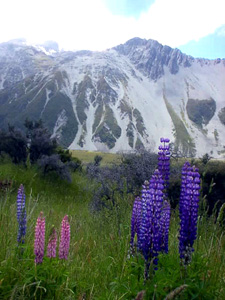
Third photo: A. Aruninta / Wikimedia Commons / Permission is granted to copy, distribute and/or modify this document under the terms of the GNU Free Documentation License / Mount cook, New Zealand
At the end of 2004, the Asian Tsunami brought horrible destruction to the Indian village of Anumanthaikuppam, in Tamil Nadu. Many of the children who were playing on the beach that day watched their playmates being swept out to sea. They were severely traumatized.
The C.P. Ramaswami Aiyar Foundation, right after the tsunami, spent a month with the whole staff traveling up and down the coast helping afflicted people wherever they could. They rebuilt one entire village, now called Wooster Naga.
In the village of Anumanthaikuppam, with support from the Vasant J. Sheth Memorial Foundation in Mumbai, they provided relief assistance to 170 families in the form of food, utensils, blankets, stoves, buckets, and lanterns. Students were given books.
Just as importantly, they built a playground and amphitheater there for the children. While the workmen were constructing the playground, Dr. Nanditha Krishna, the Honorary Director of the C. P. Ramaswami Aiyar Foundation, spent time talking with the village people.
Realizing that they had been sacrificing animals in the village temple, she explained to them that it was not good to do that, and even extracted a promise from them that they would discontinue the practice. Though she confesses that she did not expect them to keep their promise.
At the temple of Anumanthaikuppam, two village goddesses were being worshipped; the boundary goddess, Ellai-amman and a very bloodthirsty goddess, Kali-amman.
Just recently, in April of 2012, seven years later, village leaders from Anumanthaikuppam arrived in Chennai to let Dr. Krishna know that they had indeed kept their promise. They had given up animal sacrifices and had built a completely new temple. They invited her to attend the temple consecration, known as the kumbhaabhishekham, on May 4.
The goddess that they now worship is not at all the same fierce goddess, but is instead a peaceful, benevolent goddess.
After attending the consecration on May 4, Dr. Krishna described the new temple, “The temple at Anumanthaikuppam has been rebuilt with a huge vimaana and shrine for Ellai Amman and individual shrines for Ganesha, Subrahmanya, Shiva, Vishnu and Ayyappa. There is also a separate shrine for Kali.
“The original stone figures of the two goddesses – very fierce-looking, as I remember – have been buried under the temple and new, smiling and peaceful-visaged goddesses installed in their place.”
The village priest who used to perform the animal sacrifices had been replaced by fifty Vedic Brahmin priests. Brahmin priests study the ancient Hindu scriptures, the Vedas, and they have a tradition which goes back thousands of years of being totally vegetarian and of great reverence for animals, so their presence at the temple ensures that no animal sacrifices will ever take place there.
Dr. Krishna wrote, “It was a pleasure to watch the 10,000-strong fishing community mingling with the Brahmin priests – over 50 of them. There were lots of shops selling odds and ends. But no fish was sold on the premises.”
The village headman told her that out of respect for her wishes, the entire temple premises would be kept “vegetarian.” There would be no harm done to any animals. She wrote, “Ellai Amman and Kali have now become peaceful deities…There is a goodness in human beings which merely needs to be tapped.”
This is a remarkable event. Not only have the children of Anumanthaikuppam, who had suffered terribly, and all the village people, been helped after such an immense disaster, but they responded in return with kindness towards animals. It is a testimony to the transformative power of communication and kindness – and of how much good can come from putting the two together.
An Associated Press article carried in the Washington Post on May 1, 2012, reports that WildEarth Guardians is challenging in court the practice by the Wildlife Service, an arm of the U.S. Department of Agriculture, of killing millions of wild animals every year.
While the American public generally assumes that the government is protecting the nation’s wildlife, in fact, the Wildlife Service (not the same as the U.S. Fish and Wildlife Service, which is a different branch of government) is killing bears, coyotes, wolves, cougars, and many other species, including millions of migratory birds, and sometimes accidentally killing Golden and Bald Eagles and people’s pets as well.
The lawsuit by WildEarth Guardians states that scientific studies which prove that predators are an essential, beneficial part of the eco-system are being ignored by the Wildlife Service, and that current environmental impact studies are not being conducted.
The Washington Post reports that the agency spent $1 billion to kill around 23 million animals between 2004-2010.
The killing of animals by the Wildlife Service is in response to local requests to protect agricultural crops and resources, including farm animals, from predation. The lawsuit maintains that the program benefits mostly large agribusinesses, and needlessly kills wildlife that are meant to be under government protection.
The Sacramento Bee is running a very informative three-part series on this issue.
Congratulations to WildEarth Guardians for taking this important step to hold the Wildlife Service accountable for the deaths of so many wild animals.
To read the original article in the Washington Post, click here.
For the link to the Sacramento Bee series, and to see how you can help WildEarth Guardians in their valiant efforts to protect American wildlife, click here.
Lakshmi’s life was saved at the Karuna Society for Animals and Nature, in Puttaparthi, Andhra Pradesh, by surgery that removed a vast quantity of plastic bags. Since then she has given birth to her calf, now six weeks old, and the two are happy, healthy, and well cared for.
However Lakshmi’s situation was not unique. It has been discovered that the problem of cows eating plastic bags is universal in the cities of India.
A profoundly moving documentary, The Plastic Cow, examines, not only the current plight of the cow, but also the long history of the cow in India, going back through thousands of years of reverence for the sacred cow. One young boy in the film, Vishnu, sums it up by saying, “Cow is God.”
The traditional worship of the cow contrasts sharply with the circumstances of the cow in India today.
Although the life-saving surgery performed on Lakshmi is shown in graphic detail, the film is beautifully done, with great dignity and perception, and a remarkable lack of blame or negativity.
The music, the narration, and the cinematography are extraordinary. The film speaks with the gentle voice of India and gives a very moving presentation of reality, with statements by well-known animal advocates; among them Clementien Pauws, Philip Wollen, Rukmini Sekhar, Dr. Chinny Krishna, and Pradeep Nath.
It is a true vision of India, encompassing all its multiplicity of paradoxes, with its beauty and its tragedy, and a call by the group, the Plastic Cow Team, to do away with the use of plastic bags which inflict such suffering on the cows and other animals of India.
The Winsome Constance Kindness Trust, in Australia, has provided funding for all the cow surgeries performed by the Karuna Society for Animals and Nature. The documentary was funded by a number of individuals and groups.
This past February, when I first heard that we’d be visiting a bird sanctuary, I thought to myself, “Oh, we’ll probably see half a dozen water birds, they’ll be beautiful, and we’ll have a nice time.”
So I was little prepared for the mesmerizing sight of tens of thousands of extraordinary birds, mostly Painted Storks, perched in every tree over countless islands as far as the eye could see! The most amazing view of birds I’ve ever seen.
“Vendanthangal” means “the hunter’s resting place,” but, despite the name, there are no hunters, and the people are very protective of the sanctuary and the birds.
Painted Storks, Black-headed Ibis, White Pelican, and others
Vendanthangal Bird Sanctuary, in the Kanchipuram District of Tamil Nadu, in southern India, is a 30 hectare (74 acre) sanctuary, 75 kilometers (47 miles) south of Chennai, and if you have even a passing interest in birds, it’s really a captivating place.
An overview
It’s a very large, shallow lake, filled with many, many islands where the trees are nesting sites for the birds. As we walked along, on the pathway beside the lake, there were spectacular views of the birds. There was also a tower for a more elevated view. The birds were a comfortable distance away, close enough to be seen, yet far enough not to be disturbed by our presence. And stretching into the distance were thousands of white dots of birds on more distant islands.
The most dramatic and the most numerous are the Painted Storks, who seem designed to make a big impression – with a deep orange head, a lighter orange beak, and splashed onto their white bodies are black wings with white polka dots, and pink tail feathers. They look like they’ve just gotten dressed up to go to a prehistoric party as they stand on their long skinny legs in the water or in the trees, chatting with each other. They fly with their legs stretched out behind and land with their black and white wings spread out. The babies, who as fledglings are the same size as the adults, are gray, and perch in the trees too. There is no advantage in the natural world for babies to have bright colors, since being inconspicuous protects them from catching a predator’s eye. So they sit and wait for mom and dad to come back to them with dinner. They stand around three feet (one meter) high.
Black-crowned Night Heron
Originally, Painted Storks migrated all the way from the Himalayas, arriving in India in the fall, breeding in the winter, and then returning back north each spring.
The Painted Storks at Vedanthangal do not travel all the way back to Siberia. They migrate locally, moving with the seasons to nearby lakes, traveling at most within a range of 100 kilometers (60 miles).
They are also found in Andra Pradesh and near Delhi.
The Little Cormorants, who are small, around 55 centimeters (21 inches) elegant, slender black birds, like to perch together in the trees. They do not migrate, but stay here year round. Found throughout south Asia, they have webbed feet though they perch in trees.
Among other birds we saw at Vendanthangal were the Black-headed Ibis (or Oriental White Ibis), Cattle Egret, Grey Heron, Black-crowned Night Heron, Intermediate Heron, Indian Darter, Cinnamon Bittern, Great White Pelican, and several ducks.
A March 1, 2001, Times of India article “Twitchers in a flap over rare sightings” by D. Madhavan, TNN, reports than a team of forest officials and other experts conducting a two-day survey on February 21 and 22 spotted a number of rare birds, many never seen here before. Among them a pair of Comb Ducks and fifteen Shovellers may have come from Pakistan. Also found in Pakistan and in southern Japan too, were ten Spot-billed Ducks. Twenty Pintails had arrived, ducks that are found farther north in Europe, Canada, and Russia. Fifteen Garganeys, a dabbling duck that breeds in Europe and parts of Asia, were also spotted. Garganeys are strictly migratory and their entire populations relocate for the winter, especially to India.
We did see a few ducks, but they were quite far away and whether or not they were rare species was impossible to tell.
A wading bird, the Black-headed Ibis, walked along in shallow water, sometimes feeding with her head submerged under the water. We saw several flying and a few perched in the trees.
Cattle Egrets seemed to enjoy the company of other species and were perched in the trees near Little Cormorants and Black-Crowned Night Herons.
Grey Herons
The Grey Herons looked remarkably like the Great Blue Herons we see in Utah, but without the blue. They are large gray and white herons.
Intermediate Heron and Common Bitterns
The Intermediate Herons have long black legs and are larger than the Cattle Egrets. We saw one in a rice paddy near the entranceway to Vedanthangal, along with one adult female, and several juvenile, Cinnamon Bitterns. All were happily searching through the water for food.
A few Great White Pelicans flew overhead or swam in the water. One Indian Darter, also called a Snake Bird was perched on a branch in the company of dozens of Little Cormorants, recognizable because his neck was a golden color, and he (or she) held it in a curved position, rather snakelike. They are actually anhingas and not cormorants at all.
Indian Darter and Little Cormorants
At sunset, along a road off to one side of the sanctuary, on a lower level, cowherds began to lead their cows back from grazing in nearby fields, leaving the night to settle peacefully over the roosting birds.
The Wikipedia article “Vedanthangal Bird Sanctuary” says that the local people have always understood the benefits to their crops of having the birds nearby. The birds’ droppings act as fertilizer. Around the end of the 1700’s, they complained to the British Collector about British soldiers who were shooting the birds, asking that a proclamation be issued to protect the lake, which was done. In 1936, it was legally recognized as a sanctuary. Now the Venganthangal Lake Bird Sanctuary falls under the Wildlife Protection Act of 1972. For at least 250 years and probably for eons longer, the people have been protecting this beautiful place of peace and refuge.