Utah crows need your help
Click on the link below, to see how to send an email to help prevent a crow hunt from taking place in Utah. It doesn’t matter what country or state you live in, your help will be much appreciated…

India: Press statement on The Hon’ble Supreme Court’s Verdict on the use of bulls in entertainment

By Dr. Nanditha Krishna
May 7th, 2014 will go down in the history of India for the landmark verdict given by the Hon’ble Supreme Court of India to ban the use of bulls for entertainment. This includes jallikattu, rekla (bullock cart) races and horse-and-bull races.
I am extremely delighted and would like to take this opportunity to congratulate each and every one who has worked for years to achieve this verdict.
I must particularly mention and thank Mr Jairam Ramesh who, as Minister for Environment and Forests, banned the use of bulls as performing animals in 2011. Subsequently, the Tamilnadu government permitted jallikattu through the Tamilnadu Jallikattu Regulation Act of 2009, while the Ministry of Environment and Forests withdrew its own Gazette notification through an affidavit to the Supreme Court this year. The Animal Welfare Board of India, to its credit, refused to go along and fought the Tamil Nadu government, the Jallikattu Federation and the Ministry of Environment and Forest’s stand in the Hon’ble Supreme Court. By its historic verdict, the Hon’ble Supreme Court has vindicated Mr. Jairam Ramesh’s position and upheld the ban.
Jallikattu is a cruel practice in which crowds of young men pursue and torment bulls, often leading to injury to the bulls and to themselves in the process. There is nothing intellectual or cultural about fighting bulls. Jallikattu owes its origin to man’s domestication of cattle, which gave him the draught power of the bull and milk from the cow – and power. But culture is not static. Just as we have evolved and given up sati, human sacrifice and child marriage, we must give up bull baiting and racing bulls too.
[The following is a description of abuse inflicted on the bulls, which may be disturbing…Editor]
During jallikattu, bulls are deliberately terrorized and made to suffer for entertainment. They are taunted by crowds, their tails twisted and broken, hit, wrestled to the ground and beaten and prodded with nail studded sticks, not to mention the chilli powder that is thrown into their eyes to craze them or the alcohol poured down their throats. No amount of regulation could stop either bulls or people from being hurt. Jallikattu is one of the most barbaric and gruesome traditions of India, using bulls for entertainment purposes, and violates the Prevention of Cruelty to Animals Act, 1960.
Dr Nanditha Krishna
Founder, CPR Environmental Education Centre
Chairperson, Humane Society International-India
Governing Body Member, Blue Cross of India, Chennai
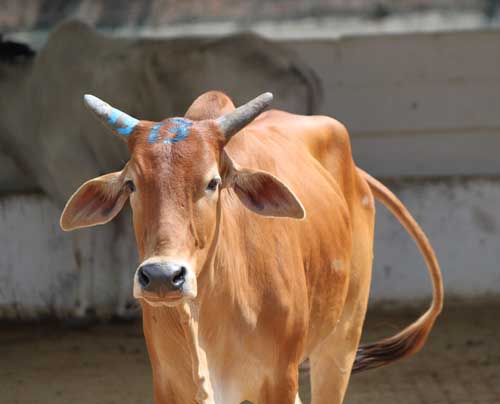
Photo: Sharon St Joan / Not a jallikattu bull, but a bull rescued from illegal transport by Blue Cross of India.
BREAKING NEWS: VICTORY FOR THE BULLS! Tamil Nadu: Jallikattu before the Supreme Court of India, Part Two

By Sharon St Joan
Continued from Part One.
To read Part One first, click here.
BREAKING NEWS: It has just been announced (on Wednesday, May 7 in India) that the Supreme Court of India has banned all jallikattu events, also bullock cart racing, and all forms of cruelty to the bulls that were before the court. This is a landmark victory that frees the bulls from centuries of abuse. It comes after more than forty years of intense work on behalf of the bulls by so many animal groups and people in India.
Dr. Nanditha Krishna, one of those who has worked so long for the bulls, said, “Jallikattu was such a barbaric custom. We are all so happy it has stopped! We were all praying for the bulls!”
“Tamil Nadu will burn.”
Following Jairam Ramesh’s ruling, when the High Court of Tamil Nadu was just at the point of banning jallikattu, the lawyers representing the sport’s promoters issued a dire warning that the jallikattu events for that year were already well beyond the planning stage, and that if they were canceled, then “Tamil Nadu will burn.” This threat of violent civil unrest gave the judges pause for thought, and they declined to ban jallikattu, much to the dismay of animal advocates.
Earlier, on November 27, 2010, the Supreme Court of India had refused to ban jallikattu, despite an appeal by the AWBI. The Court stated that there were already in place adequate safeguards to protect people from injury and the bulls from cruelty.
Concerning the duty of the courts, Dr. Chinny Krishna maintains that “The courts are there to uphold the law and to protect the rights of the less powerful – children, women, and animals too…. Jallikattu is illegal and the courts will rule that it is illegal….The court of last resort is the people.”

Back to the Supreme Court
The Tamil Nadu Jallikattu Act, allowing jallikattu, was passed in 2011, going against the Prevention of Cruelty to Animals Act that had been passed back in 1960 by the central government. The AWBI then filed the most recent case in the Supreme Court of India, asking that jallikattu be banned, and also that the Court consider at the same time other issues related to bulls, such as bullock cart races in Maharashtra and the illegal transport and slaughter of cattle.
Despite all the many efforts to have jallikattu banned, and despite the fact that mistreatment of the bulls contravenes Indian animal welfare law, the High Court of Tamil Nadu and the Supreme Court of India have so far declined to ban jallikattu events.

Now, with the new case being brought to the Supreme Court, filed on different grounds, there is a renewed expectation of protection for the bulls.
Legal setbacks notwithstanding, there have over the years been significant successes. Thanks to the efforts of the AWBI and many Indian animal organizations, far fewer jallikattu events take place now than in past years. Jallikattu is only allowed to take place during five months of the year, not year-round as before. A substantial fee must be paid in advance in order to receive a permit to hold the event, and AWBI inspectors are required to be on scene, as well as veterinarians for the animals and medical personnel for injured participants.
Will there be jallikattu next spring?
Jallikattu events begin in the spring, during the important south Indian harvest festival of Pongal. As Dr. Krishna pointed out, sometimes the same people who, as part of the Pongal celebration, go to the temple in the morning and pay reverence to the cow, also attend jallikattu in the afternoon, where the bulls are tormented. The inherent contradiction in this seems to go unnoticed by jallikattu enthusiasts.
As Dr. Krishna explained, “Although forms of jallikattu may go back a long way and ultimately are part of the chain of events going back to the domestication of the cow, it is only over the last 300 years of so, that jallikattu has really taken off as a major attraction.”
The young men of the villages attempt to retrieve a bag of coins tied to the horns of the bull, so there is a monetary prize, and, in early times, the winner also won the hand of the chieftain’s daughter.
Today Jallikattu revolves around money. It is a huge profit-making enterprise – an enormous occasion for betting large sums.

Most local people oppose jallikattu
Most local people don’t attend jallikattu events – and the majority of the population in central Tamil Nadu cities and towns, where jallikattu is held, oppose the sport.
Its support comes largely from tourists: French, German, British, Japanese and others. Among the Japanese tours that frequent jallikattu are some that specialize in pilgrimages to Buddhist sites – ironic in light of Buddhist teachings against animal cruelty.
The Supreme Court of India calls jallikattu “barbaric”
Now, with the new jallikattu case before the Supreme Court of India, being heard by Justice Radhakrisnan and Justice Pinaki Ghosh, the Court has expressed amazement that this kind of barbaric treatment of animals is still taking place in the twenty-first century. Animal groups are guardedly confident that the Court will rule that against jallikattu and that this cruel “tradition” will at last be a thing of the past.
Even if the court battle is not won, Dr. Krishna states that the fight to defend the bulls from cruelty will continue – with stepped-up support in the Parliament and with renewed efforts to ban this kind of animal cruelty forever, so that India, known for millennia for its reverence for animals, will uphold its long tradition of kindness — protecting and defending the bulls and all animals.
Photos: Sharon St. Joan / These are not jallikattu bulls; they are bulls rescued from illegal transport by Blue Cross of India in 2012.
Tamil Nadu: Jallikattu before the Supreme Court of India, Part One
By Sharon St Joan
Is the Supreme Court of India on the verge of banning jallikattu? And what is jallikattu?
With a case now before the Supreme Court, there is a chance that this cruel event, an Indian version of the running of the bulls, may be banned.
What is jallikattu?
Early every spring jallikattu events are held in central Tamil Nadu, in south India.
During jallikattu, the bulls are released through a gate. They then run along a corridor between two fences, required to be eight feet high, with crowds of shouting spectators held back behind the fences. In the area through which the bulls run, several hundred young men mill about, and when a bull comes running through the gate, they leap up and grab the hump of the bull with their arms, trying to hang on as long as possible until the bull throws them off. Others grab its horns, some its tail. A young man who hangs on for a specific length of time wins a prize of money. This is a terrifying experience for the bull who is being chased and assaulted by unruly crowds; the noise is deafening.
Terrifying as this event is for the animal, who has not been asked if he’d like to participate, it is the torture of the bull which goes on behind the scenes which is particularly cruel. Unlike horses who love to run, bulls do not run, it is not in their nature, unless they are either fighting or fleeing. The only way to make them run is to inflict severe pain on the animals, causing them to run. The torture of the bulls is an integral part of the activity of jallikattu, and jallikattu cannot take place without mistreatment the bulls because they won’t run. If you’d like to read a graphic description, please see the link below. This is the reason that every jallikattu event is always in violation of the Prevention of Cruelty to Animals Act – 1960, and the reason why the Animal Welfare Board of India (AWBI) continues to file appeals in court seeking the banning of all jallikattu events.

Apart from the cruelty to the bulls, every year jallikattu causes many human injuries and often deaths – not to the sponsors of these events who make a lot of money from them, but to the young men who take part.
According to a January 16, 2014 article in India Today, two jallikattu events on January 15, 2014 resulted in at least 100 human injuries, some critical. The events took place in Tiruchi at Periya Sooriyur Village and at Palamedu in Madurai.
Investigators representing the AWBI at these two events, filed 46 FIR’s (First Information Reports) with the police, alleging illegal and violent acts against the animals.
The four-decade fight to end jallikattu
For over forty years, animal advocates in Tamil Nadu, India, have been working to end this cruelty.
In the 1960’s, Captain Sundaram, Founder and Director of Blue Cross of India, one of India’s oldest and best known animal organizations, was a prolific letter writer, sending off as many as twenty letters a week to newspaper editors about jallikattu and other animal-related issues. He and his son, Dr. Chinny Krishna, also a Blue Cross Founder, regularly spoke out against jallikattu in front of audiences, large and small.
Today, Dr. Chinny Krishna, as the Vice Chairman of the Animal Welfare Board of India, continues the fight, over four decades later, on behalf of India’s animals. Under the leadership of General Kharb, Chairman of the AWBI, key animal issues, including jallikattu, are being energetically pursued. Thousands of active animal welfare groups in India, led by some of the most dynamic, tireless animal advocates anywhere in the world, pursue justice and wellbeing for the bulls and all of India’s animals.
The Animal Welfare Board of India and many Indian animal groups have for years been waging a battle in the courts to save the bulls from these painful and terrifying events.
Now, the issue is before the Supreme Court of India, which is expected to hand down a ruling soon. If all goes well, it may definitively ban jallikattu, within the next few days.
In recent years, however, the trajectory of jallikattu through the legal system has been anything but straightforward and clearcut. The courts have been going back and forth on this issue for several years, imposing some restrictions on jallikattu, while still allowing it to go ahead.

Back and forth in the courts
In August 2011, Jairam Ramesh, then Minister of the Environment and Forests, issued a ruling banning the use of bulls in performances, such as circuses, in India. This action added bulls to the list of lions, tigers, leopards, bears, and monkeys, who are all banned from being used in performances. This should have meant that bulls could not be used in jallikattu, which clearly is an animal performance.
However, there was a problem in the courts…
Continued in Part Two
To see the cruel treatment of bulls during jallikattu, click here.
(Caution, this contains graphic and disturbing images and descriptions of cruelty to animals.)
Photos: Sharon St Joan / These are not jallikattu bulls. They are bulls rescued from illegal transport in 2012 by Blue Cross of India.
Champaner Jama Masjid (Vadodara – Gujarat)

From the Blog, My Travelogue, by Bhushavali Natarajan
There are three major, historical Jami Masjids. One in Cambay, one in Ahmedadbad and finally, this one in Champaner. This Jami Masjid is believed to have been built in the last period and is of the best quality in terms of architecture and sculpture.
To read the rest of this blog, click here.
People of Maghalaya
Is the bull the enemy?

By Sharon St Joan
When watching the stock market, we talk about the bulls and the bears – why? Well, the symbolism behind this isn’t so much really about the bears, but it is about the bulls, who from the very beginning of human consciousness have been known as a symbol of power, success, and victory. The bull stands at the top of the mountain, having conquered his rivals.
In the caves of Lascaux, in southern France, 17,000 years ago, Cro-Magnon man painted extraordinarily beautiful cave paintings. The largest of these, running about 17 feet long, depicts, a bull, not a modern bull, but an ancient wild bull, the auroch, a species that existed before bulls became domesticated. They were much larger then and fiercer.
Visiting Crete in the late sixties, I was struck by the many depictions in the ruins of Knossos of the bull. Even simple blocks of stone had double bulls’ horns carved at either end. Clearly, the bull was an archetypal symbol for the Minoans, whose civilization was at its zenith, around 1500 BCE.
In ancient Egypt, the bull was worshipped as the god Apis, symbol of strength and power.
Among Native Americans of the plains, where there were no cattle, the bison assumed the place of the bull, and the bison, who provided everything the plains people needed in terms of food, clothing, and shelter, were greatly revered.
In Vedic literature and other sacred texts of India, great heroes were referred to as “bulls among men.” Throughout history and today in India, the vehicle of the God Shiva is the bull, Nandi, who guards the entrance of every Shiva temple, and the devotee pays his respects to Nandi, who then graciously allows the devotee to enter the temple and to worship Shiva.
In the Christian Bible, the ancient Hebrews got into a lot of trouble by worshipping the Golden Calf, as soon as Moses had been gone too long on the mountain. When their faith in Moses waned, they reverted to an older tradition – worship of the bull.

The Mesopotamians worshipped the bull as Marduk, a magical being – god of water and the growth of vegetation, as well as judge of human affairs.
The Canaanite god Moloch was often portrayed as a bull.
Unfortunately, the position of great honor bestowed on the bull throughout history has drawn the attention of a darker aspect of human nature, which is the desire to kill whoever or whatever stands at the top. This is not at all the same as the legitimate fight against oppression and injustice, which is noble and heroic, but instead, it is the ignoble wish to subjugate anything that might be seen as a potential rival – the basic drive which seeks to eliminate all competition in any way possible.
This instinctive drive has a positive side which may lead to success and to excellence, but all too often, throughout human history, it has instead been overwhelmingly negative — leading to the wanton destruction of all that is perceived as not subservient enough.
The desire to destroy one’s rival leads to wars, to run-away arms races, to tyranny, to the accumulation of wealth at the expense of all who are less fortunate, to the oppression of the female, the young and the old, and all who are weaker or poorer. It leads to the destruction of nature, the elimination of wild species, the devastation of the planet earth and to climate change run rampant. At its most extreme, anything that is beautiful, untamed, or magnificent is the enemy of this drive for domination and becomes a target for destruction.
All this has lead to the bull being among the most persecuted of animals in many cultures, worldwide.

The bull in ancient Crete was the object of bull-baiting in which young men leaped on the backs of the bull to ride them, thus proclaiming their victory and superiority over the bull – and their worth as “heroes.”
Bull-fighting is the modern day form of this in Spain and other countries. In Spain and in Mexico, there are lesser-known “festivals,” sponsored by local Catholic churches, which far exceed bull-fighting in terms of extreme cruelty, torture, and the killing of the bull.
There are ritual tribal persecutions of the bull in sub-Saharan Africa.
In the history of Christianity, the devil has traditionally been depicted with the horns and the tail of a bull – thus showing the bull, who is an innocent animal, as the essence and symbol of evil.
The drive to dominate, subject, torment, and destroy all that is innocent and beautiful represents the very worst aspect of human nature, and it is based on fear, the fear of being defeated and replaced.
There is though a positive, iconic figure who is just the opposite of this – the protective hero, seen for example, in the great flood myth of India in the Noah figure, Manu. Manu saves a tiny, helpless fish, who calls out to him for help because he is about to be eaten by large, ferocious fish. Manu cares for his little fish with great attentiveness, for many years, raising him until he becomes a large, strong fish and then releasing him to be free again in the sea. The fish repays him for saving his life by warning him of the Great Flood and then by pulling Manu’s ship through the tempestuous waves to the top of a mountain, to rest in safety. There, all the seeds that Manu has brought along on the boat are planted in the ground, and the life of the earth is restored to begin anew. Manu is the archetype of the positive, protective figure, noble and kind, who cares for the good and the innocent. He is the true hero.

Even India though, which has for many thousands of years worshipped and revered trees, plants, and animals, is not free from the destructive instinct to dominate, especially to dominate the bull, and this is seen in the cruel sport jallikattu, a form of bull-baiting practiced in the south in Tamil Nadu, in which crowds of young men torment and persecute bulls as a spectator sport. It is also evident in the cruelties inherent in the illegal transport and slaughter of cattle – and in bullock-cart racing in the state of Maharashtra.
These abusive practices are being opposed by thousands of animal welfare groups in India, part of an energetic struggle that has been pursued over at least the past forty years.
The Supreme Court of India is expected soon to deliver a ruling on these three forms of cruelty to bulls, which are already illegal, according to the Prevention of Cruelty of Animals Act – 1960. If the ruling upholds the rights of the bulls and the integrity of the longstanding humane traditions of India, this will be a major leap forward for animals in India and the world – and a sign that the voices of kindness and positivity are not always silenced and will sometimes prevail, overcoming all obstacles.
© Sharon St Joan, 2014
Sharon St Joan is the author of Glimpses of Kanchi.
Top photo: Prof saxx / “This building is indexed in the Base Mérimée, a database of architectural heritage maintained by the French Ministry of Culture, under the reference PA00082696.” / Wikimedia Commons / “Permission is granted to copy, distribute and/or modify this document under the terms of the GNU Free Documentation License, Version 1.2 or any later version…” / Lascaux Caves / Cave paintings of aurochs and deer.
Second photo: user:Rmashhadi / “I, the copyright holder of this work, release this work into the public domain. This applies worldwide.” / “This is a featured picture on the Persian language Wikipedia” / Marduk. Iran’s heritage in Musée du Louvre.
Third photo: Deror_avi / Wikimedia Commons / “Permission is granted to copy, distribute and/or modify this document under the terms of the GNU Free Documentation License, Version 1.2 or any later version…” / This is a duplicate, at the Minoan Palace, Knossos. The original is at the museum in Heraklion, Crete.
Fourth photo: Ramanarayanadatta astri / Wikimedia Commons / “This work is in the public domain in India because its term of copyright has expired.” / The fish Matsya pulling Manu and the seven rishis.