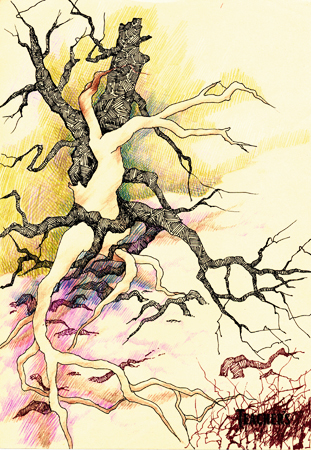
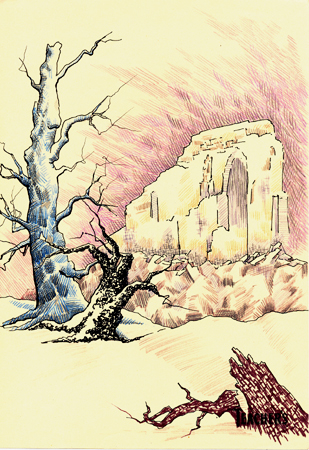
“Vriksha” means “tree.” S. Shankar’s remarkable paintings invite us to see trees and all of the environment as living, sentient beings to be valued and protected.
S. Shankar lives in Kolkata, India, and recently held the exhibit, “Vriksha – a Saga of trees” at the C. P. Art Centre, in Chennai.
Oumou Sangare, performing at a concert in Portugal, 2007
Oumou Sangare – There’s a region in Mali called Wassoulou which has a really famous musical tradition. Its music stems from traditional hunting songs, and is usually sung by women, often focusing today on issues specifically facing women. One of its most famous singers currently is Oumou Sangare. She comes from a long line of musicians. And she’s not only a terrific Wassoulou performer with loads of personality, but true to her musical genre, she’s a huge advocate for women’s rights. She’s extremely vocal against child marriages and against polygamy. And she herself is a savvy business owner (hotel and automobile business) who tries to set an example to other ladies that financial independence is a form of freedom. A great singer and an impressively stubborn soul! Here she is:
Near the Khyber Pass
Aiman Udas – This is a lovely Pakistani singer, who was, very tragically killed by her family a couple of years ago. Allegedly, it was done by her brothers, as an “honor killing” because they thought she was a disgrace (both for being a woman who sang in public and for being divorced). They left both of her children orphaned, without a mom. Not much honor in that! So I say we spread videos of her singing in public all over the world. She gave her life to her art, and she deserves to be heard. Click here.
Canyon de Chelly, Arizona
Connie Dover – She has one of my favorite voices. Truly an American treasure, this Arkansas-born lady composes and performs music that draws out the richness of American soil. She sings from a place of spirit and a sense of the heavens, while grounding every note in the earth. Some of her songs echo slightly of Scotland’s or Ireland’s reverberations on the United States, while others hint at ancient whispers of Christianity that have crossed the ocean, and some are even ticklish with thoughts of love, but many of her songs simply seek the grasp the sheer expansiveness of the American experience, and particularly, the massive American West. Here she is, singing at a Cowboy Poetry expedition. Click here.
Top photo: Bunks / Oumou Sangaré in Sines Portugal 2007 / Wikimedia Commons / This file is licensed under the Creative Commons Attribution 3.0 Unported license.
Second photo: James Mollison / Wikimedia Commons / This file is licensed under the Creative Commons Attribution-Share Alike 2.5 Generic license. / Taken at the Khyber Pass, near Peshawar, Pakistan, where Aiman Udas lived
Third photo: Sharon St Joan / Canyon de Chelly / Arizona
MOOSA and SHERRY were two black Labrador cross siblings who arrived in our home in 2002. They had belonged to an NRI who lived in the Middle East. Unable to take care of the one year-olds, his family members dropped them off at the Blue Cross of India. I was in search of a Dr. Dog after the death of my Dr. Jumble, so Mrs. Saraswathi Haksan, Hon. Secretary of the Blue Cross, decided she would drop them both off chez moi. Moosa and Sherry were very cute. When two bowls of food were placed before them, they would both eat from one and then from another. I realised that Sherry, the female would never make a Dr. Dog – she was too full of nervous energy. Moosa was placid and laid back, an ideal doctor. But we had to wait.
Pet therapy began at Saraswathi Kendra with Cleo in 1996 and Sachin in 2000-2001, two aggressive little dachshund puppies who became neurotic after their experience. Saraswathi Kendra Learning Centre for Children (SKLC) is the first full-time school in India for children with Autism, Learning Disabilities, Dyslexia, A.D.D., behaviour and habit disorders, established in Chennai by The C.P. Ramaswami Aiyar Foundation in 1985. Assessment, therapy, and education services are provided. It is affiliated to N.I.O.S. for Std. X and Std. XII and vocational education. SKLC uses innovative therapies like Yoga, Art, Dance and Movement, Puppetry, Pet therapy. It has unique facilities: A Soft Room, a Dyslexia Lab and Autism Lab. SKLC has pioneered the use of Animal Assisted Therapy for autistic children in India since 1996.
We knew pet therapy worked. Our first success story using pet therapy was with Sachin, the dachshund, who worked with Roshan Vishal, a severely autistic child who never spoke till the age of 9. His first words – at age 9 – were “Sachin, I had uppuma for breakfast. What did you eat?” Till then, nobody knew if Vishal would ever speak. Today, he studies in a regular school. But Sachin the dachshund was unsuited for pet therapy and became neurotic in the company of children. The pet therapy programme had to be discontinued.
Roshan Vishal's writing about Sachin
It was not till Jill Robinson of Animals Asia Foundation – who had conceived and developed the Dr. Dog brand and product – came down to Chennai in 2001 to assess and confer the “Doctor” title to Jumble, my mongrel, that we learned to carry out Animal Assisted Therapy systematically. AAT works with animals in a planned way to increase desirable behavior, to improve abilities, to decrease undesirable behavior, and to help individuals communicate. It must be a planned programme.
Dr. Jumble and Dr. Babe, two earlier Dr. Dogs, had some outstanding successes, like Roshan Vishal. Dr. Jumble had her diet and feed checked by Sneha every day. Girish regularly asked questions about Dr. Jumble. Two autistic brothers started speaking to Dr. Babe, another Dr. Dog. Girish petted, played and spoke to the dog (about the dog) for the first time, at age 9. Abhirami, a very withdrawn child, began to mingle in a group after playing with Dr. Babe at age 8. Children wanted to learn more about breeds and looked up the Dog Chart to identify different dogs. Many with motor co-ordination problems started playing ball with Dr. Babe.
A Dr. Dog has to be at least two and spayed/neutered to be assessed. The siblings were below one. We decided to use the year to train them. Mr. Rangarajan of Woodstock Kennels was of great help. He trained them professionally. Not too much, and very kindly. They learned to walk, sit, lie down, come to heel, shake hands and generally became much more subdued. Siva of the C.P. Ramaswami Aiyar Foundation was also trained to be their trainer.
Moosa started work in 2008. It took a while to introduce him to the children of SKLC. He was big and looked ferocious, and the children were scared. Initially they feared touching him, but soon realised he was harmless.
Moosa’s first students were Rutunjay, Aditya, Saraswathi and Shruthi. The first two patted and kissed him, for they were used to dogs. The last two were scared. Premkumar, an autistic child, was terrified of dogs and refused to respond. On July 8, 2009, he patted and played with Moosa, a major step forward.
More children joined in: Pavithra, Amrutha, Akshay Anand, Swati, Deepthi, Pranav, Arjun. The children had varied problems: LD, dyslexia, autism, ADD / ADHD. They were given instructions which they learned to hear, obey, and follow. Take Moosa for a walk. Take him to sit under the tree. Shake hands with Moosa. Tell the dog to come, to sit, to shake hands. Count ten steps with Moosa. Swati, who had interacted with Moosa earlier, referred to their past association. Deepthi told Moosa how she had played with the dog in her house. Arjun was interacting with a dog for the first time and was very curious, asking questions about Moosa’s habits.
After some time, the children became bold, welcoming Moosa, taking him for a walk around the campus and so on. There was visible improvement in the children: they began to show excitement when he came, petted him, spoke to him and so on.
Then a new plan took shape. Each child was asked to introduce Moosa to the others on different days. This forced them to acknowledge the other children, a major step for the austistic. There were certain ways to maximize the positive effects:
• Asking questions – Have you ever had a pet? What is your favourite animal?
• Speaking through the dog – Moosa wants to meet you today. He is very excited to meet you!
• Asking the child about the dog – How is Moosa feeling today?
It was important to give the child and dog their personal space, yet allow for contact. The children were empowered to care for the dog (giving water, feeding), and using the dog as a focal point to encourage communication. The bond between child and dog is beautiful. When asked to write and essay on “My best friend”, each child wrote about Moosa.
The therapist had to ensure that children were aware of the dog’s needs and feelings, thereby teaching them to be unselfish, sharing (one child must not monopolise the dog) and caring. Children were allowed to talk freely about what they feel about dogs and other animals. Discipline and acceptable behavior was made clear. The children had to pay attention to instructions. This increased their concentration skills.
Dr. Dog has specific benefits for the autistic, such as
• Increase in verbal communication
• Increase in initiative
• Involvement in activities
• Indications of pleasure
• Increased co-operation with teachers
• Decrease in negative and stereotypical/repetitive behaviour, including temper tantrums
Animal therapy engages the attention of children with various learning problems in a way that conventional therapy cannot. They score higher on measures of empathy, self-esteem and self-concept. Cognitive and social development is helped. They develop a longer attention span, co-operation, and greater focus in the classroom.
Dogs provide unquestioning love and attention, relaxation and a healthier lifestyle; an outlet for care-giving, making children feel needed; stable and less complicated relationships, security and stability; and provide a link to the natural world. Dr. Dogs are non-threatening. They create a sense of capability – even superiority – in a child with learning problems and disabilities, who would hesitate to respond to adult superiority. They give unquestioning and undemanding love to a battered and unhappy child, and are very calming and soothing.
A Dr. Dog must be at least two years old and healthy; males and females must be desexed (to reduce aggression and tension); vaccinated up-to-date, with proof; calm and friendly by nature – no fighting breeds; have basic obedience skills; must have lived with handler for at least 6 months prior to examination; clean – not dressed up in costumes; and must be on a leash whenever he/she is with children.
But the role is also stressful. If the dog shows a reluctance to leave home or even move, a reduced attention span, pants excessively or has loose stools, urinates in unusual places, ignores commands, and shows behavioural changes, changes in sleep patterns and unusual activity, he cannot be forced to act as a Dr. Dog.
The nagalingam tree where Moosa was laid to rest
Moosa’s last few days were painful, with liver and then kidney failure. The children were anxious and worried. The day before he died, they all came to see him. He was tired and ill, but he put out his hand and shook hands with his friends. The next day – February 1, 2012 – Moosa died suddenly. We did not want the children to know, but news travels fast. All his students swarmed around as he was laid to rest under a beautiful flowering Canonball (Nagalingam) tree. They were sullen and confused. They did not understand death, but they knew Moosa had gone. They would miss their “best friend”.
Dr. Jumble and Dr. Moosa were my own dogs and, as the founder of SKLC, I was able to experiment with this programme conceived by Animals Asia Foundation at SKLC, which is next to my house, where Jumble and Moosa lived. But it has its problems. There are several schools clamouring for a Dr. Dog, but they are not available. It is difficult to find desexed dogs, since owners of gentle breeds like the Labrador hesitate to sterilize their dogs. Also, their owners are busy people who do not have time to take their dogs to schools during the day.
Dr. Dog is a very successful therapy programme which can change the lives of children with varying problems and needs. It needs the co-operative efforts of dog owners and special schools to function effectively.
Yim Sang — I think Cambodia has an interesting history. Once upon a time, it boasted the largest urban center in the world. Angkor was the envy of the lands for a long time. Hinduism thrived, then later Mahayana Buddhism, and the society was apparently relatively prosperous, comfortable, and I even see hints a great deal of respect for both genders. They had ups and downs, including some wars and a Dark Age, and a little period of being owned by the French. But in many ways, including musically, they really continued to thrive. They switched to Theravada Buddhism, they continued along. And then in the 1970s, the absolutely unimaginable happened. The Khmer Rouge rose up from within and killed …. Everyone. Anyone who wore eyeglasses (because they looked smart) … anyone who sang a song … anyone who danced …. Anyone who prayed … anyone Chinese or Vietnamese … anyone who wasn’t marching fast enough …. anyone. Torture became commonplace. The once mighty and prosperous Cambodia was reduced to … something unthinkable. They’re recovering – but can you ever recover completely from something like that? It’s no wonder that today, there’s a movement to “Save Khmer (Cambodian) music.” The Khmer Rouge did everything they could to wipe it out! But the Cambodian Living Arts is working hard to try to revive the artistic world of Cambodia, and to teach people how to sing and dance again. They post a lot of videos on YouTube, so let’s help them get authentic Khmer music out there again, for people to see. Here’s a look at one they’ve put up of a grand master of Cambodian woodwind instruments, Yim Sang, now 85 years old, who somehow survived it all. Click here.
Bob Marley in concert, Zurich, Switzerland
Bob Marley – A lot of people wouldn’t know what Rastafarianism is if it hadn’t been for Bob Marley. It’s a religion that originated on the small island of Jamaica, which proclaims that all humans came from Africa, and that basically (I’m going to get this a little bit wrong), the farther they’ve gotten from Africa, the more they’ve strayed, and become Babylon (an evil place) instead of Zion (a good place – the original Africa.) They also believe that Ethiopia’s final emperor was a prophet or a special son of God.( I now apologize to all Rastafarians for not getting it quite right!) But it had been a much more obscure religion worldwide before Bob Marley came along. His music and his soul moved so many people, that in many ways he put both his country, Jamaica, and his religion on the map for all time. I’ve always heard him as more of a singing spirit than a musician. Here he is, singing a classic:
And no Bob Marley fan would forgive me if I didn’t also post a link to him singing No Woman No Cry, now that he’s on their minds. Here you go!
Bodiam Castle, East Sussex, England
Anonymous 4 – Choral music has been a European tradition since Ancient Greece. It’s singers singing a song in unison, often in many different vocal ranges simultaneously. It can be all men singing, or all women, or most commonly, a mix of men and women in order to get the full effect of high voices and low voices singing the same song at the same time. Choral music flourished a lot during Medieval times and the Renaissance, and the female chorus, Anonymous 4 is dedicated mainly to choral music of the Medieval era. (Though they do pay homage to choral music throughout time.) Most people I know who love music own at least one album by these ladies. Their music is widely regarded as a staple in any respectable music collection! And they really do bring an older, slightly more nervous, but also more haunted age in history to life with every song. Click here.
Top photo: Wikimedia Commons / Luc Viatour / www.Lucnix.beLuc Viatour / This file is licensed under the Creative Commons Attribution-Share Alike 3.0 Unported license. / Sarus Crane, native to Cambodia and other Asian countries
Second photo: Wikimedia Commons / Ueli Frey / http//www.drjazz.ch/album/bobmarley.html / This file is licensed under the Creative Commons Attribution-Share Alike 3.0 Unported license.
Third photo: Wikimedia Commons / This file is licensed under the Creative Commons Attribution-Share Alike 3.0 Unported license. / Attribution: WyrdLight.com Bodium Castle, East Sussex, England
Entrance to one of thousands of Tamil Nadu temples -- the Temple of Thiruvalluvar, an early Tamil saint and poet
A short distance from the temple of the village Goddess of Mylapore is the temple, also very small, of the boundary Goddess of Mylapore.
The village Goddess lives in a more central location, but the boundary Goddess lives right on the boundary. While the village Goddess gives blessings to babies and young married couples, the boundary Goddess has quite a different function. People come to visit her when they have a fear or a problem.
This is not Ellai Amman, but another south Indian Goddess.
Because she is a fierce protective Goddess, she sends away people’s fears and problems. She casts them over the boundary and far away.
In the temple is the stone form of the boundary Goddess, Ellai Amman. Ellai means boundary.
Beyond her, against the wall, is a large, looming, ferocious form, a statue dressed in red, with glaring red eyes. She looks ready to pounce. Clearly this is a warrior Goddess, who will not hesitate to combat any challenges. One can appeal to her for protection.
The stone statue in front is being washed; over her head are poured coconut milk, curd, and great globs of honey. Then, rinsed in water, she is ready to meet the day, to guard her boundaries and her people.
There were Christians also in early Madras. And according to legend, Jesus’s apostle Thomas, who first brought Christianity to India, arrived in Madras in 52 AD.
The Cathedral, called San Thome (St. Thomas), has been built over the site where it is believed that St. Thomas was buried. Below the main sanctuary of St. Thomas’s Cathedral, one can descend to another chapel below the street level. By the altar is a statue, lying stretched out, of the apostle Thomas. Underneath the floor where the statue rests, one can see the red earth, where it is said that St. Thomas was buried.
For those who believe this is his burial site, it is one of only three churches in the world built on the site of the tomb of an apostle of Jesus Christ. There is, however considerable doubt that St. Thomas really did come to Tamil Nadu since he is not mentioned in early records.
The entrance to St Mary's Church
St. Mary’s Church is even earlier and was built in the 1600’s, around 1640. It is a very peaceful site, in the midst of tall trees. Inside the church are many graves, with memorial stones, with rather sad stories; one stone marks the grave of a woman whose child passed away from an illness, and she died not long after at the age of 41. They are British people who had come to the shores of India, and there they died.
In the museum at Fort St. George where St. Thomas’ Cathedral stands are paintings of British ladies and gentlemen, some looking aloof and rather condescending.
In another room of the museum are displayed many weapons and canons. My guide Vasan explains to me that the British did not let Indians manufacture rifles and pistols. All these firearms are imported, brought by ship to India. Also on display, however, are many cutlasses, knives, daggers, and swords, manufactured by Indians, using a knowledge of metallurgy unmatched anywhere in the world.
One of the museum’s descriptive accounts tells the story of wars on Indian soil, between the British and the French. While Britain and France were fighting in Europe – and also fighting in the French and Indian War in the New World – apparently they also deployed forces made up of Indian soldiers to battle each other in southern India. Perhaps they felt — why not extend wars as far across the world as possible, and if it’s on other people’s land, well so much the better?
The land on which Fort St. George stands was bought by the British from its Indian owner, the Raja of Chandragiri. The British ownership of Indian lands expanded when they gave loans to maharajas and nawabs who led pretty dissolute lives, waged wars and could not repay the loans. The British ended up taking over the lands. The rest the acquired by purchase and / or war.
In this way, the British gained power, and the Indians lost the power that they had. And before they knew it, India was a colony of Britain and part of the British Empire. It happened one little step at a time. The British never had much military force in India, but, being masters of wielding the appearance of power, they always gave the impression that their armed forces were much greater than they really were.
First there was the East India Company, who arrived in India to engage in trade. Then it was necessary to provide armed forces for the protection for the British who were carrying out the trading. Then, bit by bit, the whole of India fell into the hands of the British – who did not leave until 1947, around four long centuries after they arrived.
Top photo: Sharon St Joan
Second photo: Wikimedia Commons / This photo is in the public domain.
Mylapore means land of the peacocks. “Mylai” means peacock. It is the oldest section of the city of Madras, in Tamil Nadu, and it was once a village surrounded by forests where peacocks roamed.
There are written records of this village going back to the first century BC.
In Mylapore, there is a small, simple temple to the original village Goddess Mundakanni Amman. Amman means Mother Goddess.
On the left of the courtyard is the sacred temple tree, an old banyan tree. Packed tightly around the foot of the tree are many small stone statues; most, except for one or two ganeshas, are nagas – naga is the snake god, a fertility god. The stone statues and the prayer cloths tied around one of the branches are offerings given to the tree along with prayers for the birth of a child.
The gopurum over the temple of the village Goddess
When children are born or when a couple is newly married, they are presented to the village Goddess for a blessing.
At the center of the temple, the Goddess sits, a tiny figure who looks very much like a rag doll. Around her is a big metal structure, maybe eight feet high and eight feet across — a metal covering over stone, which forms a sort of halo around the Goddess.
Half a dozen worshippers stand nearby as the priests perform the daily puja for the little sitting Goddess. First she is given a bath as they pour over her curd, coconut milk, and honey. One of the priests breaks coconuts on the stone floor with a loud cracking sound. After her bath, they drape over her a clean cloth, with a lovely pattern. One can see clearly poking out from under the cloth, which is her dress, two small feet – the feet of the Goddess.
The woman standing beside me presents another beautiful cloth to the priest, and it too is placed on the Goddess as another dress. She has three dresses altogether. The priest sings a chant. Two of the devotees standing on the right have brought a child to be blessed.
Above is a roof over this part of the temple where the Goddess sits; it is a simple thatched roof, the kind people have over their homes in rural Indian villages today.
Singing a chant, the priest waves his offering tray in circles before the Goddess.
The tray holds the sacred fire and a little container of kum kum, which is powdered turmeric and lime. When the priest goes around to each of a half dozen worshippers, he places some of the powder in their hands, and they in turn place it on the center of their forehead as a way of receiving the Goddess’s blessings. There is a little container of ash on the tray where one may put an offering of money. Bananas are also offered to the Goddess, and lovely pink and lavender flowers are given to the worshippers.
Then one can circumambulate the temple, going in a clockwise direction, all the way around back behind the walled thatched roof section. Directly in the rear are the remains of a very, very old tree. Only part of the trunk has survived. This was the earlier sacred tree, now replaced by the other one in front.
There is also to one side an alcove for the seven sacred mothers; also doll-like figures, they stand in a row and have a place in many Indian temples.
A different temple, in Karnataka, dedicated to another village Goddess, Renuka
In a small alcove apart is a single naga stone statue, bearing the outline of a snake. There one may pause to worship the divine naga.
Further along is another old tree, with only the trunk remaining, stretching up through the roof. This one is a neem tree.
Around in the front again, there are thirty to forty women sitting on the ground, who have been there the whole time – off to the right of where the main statue of the Goddess is. The women hold hymnbooks and sing hymns to another icon of the Goddess, who is in front of them; this icon is not made of stone, but entirely of metal, and this is the one that is carried in processions through the streets. The stone statues are the primary sacred forms of the deities; they always remain inside the temple and are never taken outside.
At the exit to the temple, is a little pail in which are pieces of paper. These are for wrapping up the extra kum-kum (what remains after having put the dot on one’s forehead) so it can be saved for later blessings since it is sacred and comes from the temple.
The little village Goddess, Mundakanni Amman, has been here in her home for perhaps two thousand years, perhaps longer, perhaps forever. Each day she is bathed, dressed in new clothes, and given food to eat. She receives the requests of, and imparts blessings and the answers to prayer, to her worshippers, like the Mother Goddess that she is, in a spirit of immense kindness and innocence, sweet and gentle like the scent of the offering flowers and the drifting incense.
Top photo: Wikimedia Commons / author: Jebulon / GNU Free Documentation License
Second photo: Sharon St Joan
Third photo: Wikimedia Commons / released into the public domain by its author, Manjunath Doddamani Gajendragad at the wikipedia project
34 bulls are doing a lot better now that they’ve been released from a horrible transport truck and are safely in the care of Blue Cross. These magnificent animals wander peacefully in the sunlight of a courtyard, with tall trees all around. They’ve been eating hay and lots of nutritious food, and are recovering from their ordeal of three days without food or water, crammed into a tiny truck. One is still resting with an injured hip, but he is improving. Another bull is feeling lively enough to defend his turf, nudging others away from the food trough.
In the middle of the night, on February 1, Dawn Williams, Blue Cross Resident Shelter Manager, received a call from an alert traveler who had spotted a transport truck, crammed with bulls, on the highway. Transport of cattle is not illegal, but overcrowding is, and Mr. Prasad made a quick call to Blue Cross that saved the 34 bulls.
Dawn Williams, who has rescued thousands of animals, accompanied by IIT graduate student Raghav Venkatesan, rushed to the town of Tambaram, south of Chennai, where he managed, still in the middle of the night, to lodge a complaint with the police, and get the truck intercepted on the road, after a police chase.
Bulls now safely at Blue Cross
With the truck pulled over, he climbed up onto the top to take photos, recording the dreadful conditions in which the bulls were being transported, with 34 bulls in a space big enough to carry legally only six. Large numbers painted on the foreheads of the bulls indicated where they had originated. Number 14 meant they had come from Orissa, and had already been traveling for three days. As well as having no food or water, they had no protection from the sun, and they were all in a very bad condition.
The truck driver, Balasubramaniam, was arrested, and the bulls were saved from another 36 hours of suffering, since they had been on their way to Kerala.
One of the policemen on duty at Tambaram Police Station had been among the 300 or so law-officers who had attended a three-hour sensitivity training workshop, given by the educators of Blue Cross and the Animal Welfare Board of India at the Chennai Police Headquarters, as arranged by Mr. J. K. Tripathy, Commissioner of Police.
The police officer filed a complaint (a First Information Report or FIR) charging violations of the Prevention of Cruelty to Animals Act, the Transportation Rules and the Indian Penal Code. The driver is still in jail.
Most importantly, the police have seized the truck and are tracking down the person who hired the truck, as well as the destination, which was apparently a butcher in Kerala. Slaughter of cattle is legal in the state of Kerala; though it is banned in nearly all other states in India. However, illegal transportation of cattle that are destined for slaughter once they reach Kerala is a major, ongoing issue. Overcrowding and extremely abusive conditions are common. Halting this shipment of cattle will reinforce the message that illegal transport of cattle is both illegal and inhumane.
This truck was just one of over a thousand which cross the Tamil Nadu/Kerala border every single week – each carrying up to 40 head of cattle. Kerala is one of only two states, along with West Bengal, where cow slaughter is permitted.
If you are in India and would like to help put an end to this trade in bulls, please do the following:
1. Report to the police, in writing, every case of such illegal transport you see. If an FIR (First Information Report) is not filed by the police in response, write to your Director General of Police.
2. Write to the papers reporting each case you see.
3. Support your local animal welfare group – think All-India; act locally. If there is no group, form one with others who care.
Ensure that you note down the registration number of the vehicle. Since most people today have camera phones, take photos.
A picture is worth well over a thousand words.
Today bulls are no longer valued in India, as they were in the past. With the advent of artificial fertilizer, which is neither natural nor healthy, there is no longer any need for manure to be used as a fertilizer. In Indian villages, there was traditionally a cow-herding community, who made their income by grazing cattle.
When someone had a plot of land on which they grew crops, they would pay the people who owned cows and bulls to come graze the cattle on the land, leaving manure behind and fertilizing the land as they grazed. Without this useful function, bulls and male calves no longer seem as useful or as valued as before.
Written with information contributed by S. Chinny Krishna and Dawn Williams.
Photos: Sharon St. Joan / The rescued bulls at Blue Cross of India
At the entrance to the temple of Brihadeswara, a large elephant walks along with her mahout (trainer), greeting devotees. She walks on the cobblestones of the entranceway. People entering the temple see the temple elephant, and conclude that, clearly, she must enjoy being a sacred elephant, being able to greet devotees and to nibble on bananas, having no cares or worries. They notice nothing that could cause any alarm. This elephant is one of hundreds, kept in temples throughout India.
Unfortunately, there is another untold and unseen story. How did this elephant get from the forests where she was born – to the temple where she walks today on the hard cobblestones? It is rare for elephants to breed in captivity. They do not normally do so; the female elephants seem to sense that bringing babies into a world where they cannot lead natural lives cannot be a good thing to do. So, while we do not know the specific story of this individual, it is likely that this elephant, like most Indian temple elephants, was born in the wild – perhaps in the northern forests of Bihar.
When she was captured by poachers, she may have been a few weeks old; her mother was killed so that she could be captured easily without her mother coming to her defense. Then alone, orphaned, she was taken to a market, where she was sold, perhaps first spending a few months’ time with a dealer whose job was to feed her and “train” her, getting her accustomed to life in the human world. While a domestic animal like a dog can be trained, a wild animal cannot be trained, so this “training” is not really training at all, but is instead very abusive treatment. She would never again see the forest that had been her first home – never enjoy roaming among the trees with her family and relatives – or having a bath in the river.
Female elephants in the wild live their entire lives surrounded by their relatives – their mother and grandmother, their aunts and sisters, and the young males too stay with the herd until they are old enough to leave. As herd animals, highly sensitive and intelligent, they are never alone; their social structure is the most important aspect of their existence. For an elephant to be alone is like a human being who has been placed in solitary confinement. So the temple elephants who are kept as single elephants, as they most often are, are deprived of having the companionship of their own kind.
Elephants do not have hooves, like horses or goats. Their feet are not protected efficiently – and they are designed for walking on the leaves or grass on the forest floor. Walking on cobblestones is not the same thing.
It’s not really easy to catch an elephant and persuade her to go in the direction you want her to go in. An elephant is a very big creature who may just decide to go in a different direction, and this means that, in order to control the captive animal – heavy chains are placed around her legs – sometimes all four legs, sometimes just one or two legs. An ankus is used to force the elephant to go this way and not that. An ankus is a metal hook, with a very sharp end, and it is used by the mahout to direct the movements of the elephant by inflicting physical pain.
The male elephants have even more serious problems. They are feared and can be genuinely dangerous. So, in an attempt to control them, they may be beaten and confined in very restrictive ways.
There are hundreds of temple elephants in India, and the sad thing is that very few people understand their plight. Because they are considered sacred temple elephants, there is an assumption that they are well and happy. That they have been deprived of the life that they could have known in the forests has been forgotten. That they might be lonely or in pain is simply not part of people’s understanding.
There is a need for us to look clearly at the animals themselves, with the recognition that an animal who was created to roam with friends and family through tall trees, in the peace of the forest, in the early morning or the setting sun, to walk among the sounds of the forest, whose life can only be fully lived within the forest – this is an animal who is meant to live life in freedom in the wild, not in captivity.
Since they can never be returned now to the wild, temple elephants can only be happy when a place of sanctuary can be created for them where they are able to live in natural conditions, in the companionship of other elephants. What they need now is a sanctuary where they can live out the rest of their lives in peace and freedom.
Not surprisingly, Dr. Nanditha Krishna, in her book, “Sacred Animals of India” devotes many pages to the cow, since the cow is an especially sacred animal in India, where all animals are sacred.
The cow is a symbol of “dharma.” Dharma, a very complex Hindu concept, is basically righteousness. It is the right way and the right path in life.
In difficult times on the earth, it is believed that the earth takes on the form of the cow in order to pray for help from heaven.
From the ancient Indus Valley, one of the earliest carvings is a bas relief of Pashupati, an early form of Shiva. Pashupati is the God of the animals, and “pashu” is “cow” in Sanskrit, and by extension, the word applies to all animals. In the carving, Pashupati is surrounded on all sides by animals. Another Sanskrit word for cow is “go” or “gau”– from which the English “cow” is derived.
Throughout the early Vedic literature, there are countless references to the cow. She is associated with the dawn, and with speech itself. One of the characteristics of Sanskrit literature is that there are so many levels of meaning.
Indo-Iranians also worshipped the cow, and in the Zend-Avesta, the sacred book of the Zoroastrians, the Soul of the Cow is called geuvarsan or goshuran.
The world over, cows have meant wealth, and in early systems of money, the coins sometimes depicted a cow.
In ancient India killing a cow was a particularly despicable crime – equivalent to, or even worse than, murdering a human. It was punishable by death.
According to later mythology, Brahma, God the Creator, ordered that the cow be worshipped, stating that she is the mother of the Gods.
A great many words and concepts come from the cow. In India, a person may have several family names, and one of these is called the gotra, which refers to one’s ancient lineage, a bit like a clan name. Literally, it means cow pen, so there is a connection with the cow. One cannot marry another person of the same gotra, even though there could be thousands of people all over India who belong to that gotra, because they are all relatives.
In a Brahmin marriage, the entire family history of both the bride and the groom is recited. This goes back thousands of years and can take several hours. There are any number of other rituals too that have to be performed, so weddings last several days.
Gopuram (being renovated) at Brihadeswara Temple
A temple gateway is called a gopuram, and some Hindu temples have a number of gopurams, magnificent and beautifully carved. Gopuram means the cow’s village.
So much of tradition in India relates very directly to the cow.
During the shraddha ceremony (the rites performed at death), a cow is to be given to a Brahmin. When the person who has died arrives in heaven, the cow will be there waiting, and will then free the soul from all sin.
Dr. Krishna delves into the question of whether cows were killed and eaten in ancient India, looking into the evidence in literature. Although, there is some suggestion that certain elements of society may have killed and eaten cows, this was considered abhorrent by most of Indian society, back to the most ancient times.
There are numerous injunctions throughout Hindu scriptures not to kill animals, and especially, not to kill cows and not to eat beef. This has been a strict rule of Santana Dharma (the correct name of Hinduism) for thousands of years.
Ushas, the Goddess of Dawn, rides in a chariot that is drawn by seven cows.
Kamadhenu is the name of the cow who is mother of the Gods. She grants wishes to those who ask her with reverence and sincerity.
Village cows resting, in Tamil Nadu
In re-reading this account by Dr. Krishna of the cow’s central place in Indian tradition, it occurred to me that the recognition of the cow as divine throughout the history of India, into the farthest past, may have had a great deal to do with the principle Hindu doctrine of ahimsa or “do no harm,” since the cow is such a gentle creature known for being kind, generous, for nourishing her calves, and giving milk to humans too. She eats grass and harms no one, giving only good and beneficial gifts.
A civilization that worships the cow is necessarily one of gentleness and compassion, and this is a thread that runs throughout Indian history. India is a land that is fundamentally kind – not in all ways, at all times, since all that exists on the earth can be subject to cruelty or to being cruel– but there is, all the same, a connection with kindness that is very basic, that is unique, and that lies at the heart of India.
One can see this in Indian history. Great nations have typically become empires, conquering and ruling other peoples. They have launched wars and invasions (even today). India has never done this, and has limited its expansion, which was far-ranging, reaching all over Asia and even far to the west – to trade and to cultural influence – always peaceful and enlightening. Of how many countries in the world can that truly be said? There is, in my view, something entirely unique about India – and perhaps this has much to do with the sacred cow.
Top photo: Copyrighted to Himalayan Academy Publications, Kapaa, Kauai, Hawaii. Licensed for Wikipedia under Creative Commons