A word for fish

One might have hoped that CNN’s Sanjay Gupta, who has a kind, gentle manner, and who is an American with an Indian background, might be more in tune with the tradition of ahimsa.  Promoting fish farming in the oceans on his program The Next List, on September 9, 2012, isn’t going to do anything to help the world’s hunger problems.

Alleviating the hunger crisis can be done by humans eating less meat (less of all kinds of meat, including seafood, fish, and chicken) and fewer dairy products – and relying more on plant-based diets.  We’d be healthier too.

Helping the planet (and ourselves, because we live here as well) won’t be accomplished by imprisoning fish or by further extending humanity’s sphere of dominance over the seas as well as the land.  Since we’ve usurped and destroyed much of the earth already – air, water, and land – and killed most of the fish in the sea, it might be good to leave the remaining fish alone to live in peace.

Photo: © Dmitry Bairachnyi / Dreamstime.com

To leave a comment on the webpage of the The Next List, click here.

For more on the negative impacts of aquaculture, click here.

The rock formations of the Palisades – and a thought or two.

The Palisades along the Hudson River, New Jersey, USA

In the 1890’s, the huge, majestic cliffs in New York State and New Jersey, known as the Palisades, were being dismantled and turned into railroad ballast.  Ballast is the stones that form the trackbed around and underneath railroad ties. These great cliffs, made millions of years ago, were considered disposable, to be sacrificed on the altar of modern industrialization. Through the efforts and generous donations of individuals and groups who worked to have the land turned into a park, finally in 1947, the Palisades Interstate Parkway was established, and the Palisades were saved.

On August 22, 2012, History Channel Two aired an episode of  “How the Earth Was Made” featuring the geology of the Palisades and the New York City area.

The natural history of the Palisades and the whole region is a remarkable tale.

The Palisades run for forty miles along the Hudson River. During the last Ice Age huge boulders broke off from them and were carried along to be deposited in what is now Manhattan’s Central Park.

Four thousand miles away, in the Swiss Alps, there are also huge boulders that were carried along by glaciers at the end of the last Ice Age, until the ice melted, and the rocks landed where they still stand today. In the most distant past, these two sites were not as far apart as they are now.

The giant glaciers of the ice ages left traces that are visible and that can be interpreted by geologists.  The amounts of ice towering over the landscape are astonishing to try to imagine.

Fifty miles north of New York City is Bear Mountain; it has “chatter” marks, which are indicative of glacial action. Glacial scratches, or striations, are caused by the boulders being dragged along by the moving ice. Gouges in the rocks indicate that the glacier covering Bear Mountain was at least 1200 feet high. It is known, in fact, to have been much higher, at least one mile in depth.

The ice of the glacier covering the New York area (and most of North America) stretched up to four times the height of the Empire State building, and the Hudson River was formed when the massive ice gouged out a channel for the river.

It is possible to trace the outline of the story of what happened to the rocks, going back to the most ancient times.

Much, much earlier, two hundred and fifty million years before the last Ice Age, there was just one big continent on earth called pangea. It split apart, with volcanic upheavals engulfing all the land that is now Africa and Asia.  A great rift ran the length of the divide between Europe and North America, Africa and South America; which, as it widened, became the Atlantic ocean.

Ouzoud Waterfall, Morocco

In Morocco and in South America, one can find the same kind of gigantic cliffs as the Palisades. During the time of pangea, New York was adjacent to Morocco. They were next door neighbors. Europe and north Africa were a stone’s throw from North America, until the great volcanic rift drove the continents apart, leaving them on opposite sides of the Atlantic.

When we contemplate the hundreds of millions and billions of years that rocks have reigned on the earth, human history seems but a puff of smoke wafting in the wind.

Have you ever felt, at an odd moment, that perhaps you were there long ago, at a time when only the rocks were there?

Many people do not buy the popular theory that we humans are both uniquely conscious, more conscious than all other beings, and evolutionally superior, having been placed at the tip-top of the ladder of evolution; and, it doesn’t stop there — we are also presumed to be the crown of creation in the eyes of God.

It could be, though, that the eyes of God prefer to look elsewhere. Simply put, God may not agree with us about our exalted position. Instead of being preoccupied with humans, He, or She, may prefer to fly with the swifts among the cliffs and the rain clouds, or play with the monkeys in the forest tree-tops on long summer afternoons, or join the profusions of wildflowers nestled among the mountain rocks.  Who knows?

Cliffs on the North Rim of the Grand Canyon

It would seem that the rocks too have a soul – a deep, profound, immutable, sacred soul that knows and remembers all the aons – all the worlds (far more worlds than we know about) that have come and gone on this earth.  The rocks’ many-aspected souls are conscious in ways that we can never attain to. As they tower – red, black, blue, and gray giants looking out over the lands and the winding, silver rivers — they will likely remember our world too after we are gone.

The farther we, as humans, travel away from the source of life, the more lost we seem to become.  The more we “use” nature, instead of being nature, the more we do not belong.

Surely, it is only when we return to being part of nature, when we become once again the wind, the waves of the sea, the wolves in the hills, and the luminous eyes of the owl, that we may find the beauty and purpose of our existence.

The universe is longer and larger, older and more profound, than we can imagine, and a little humility on our part might not be amiss.

For a perspective on the vastness of all things, it is written in the Ramayana, one of the great epics of India, that once, ages ago, the hero Rama shot an arrow deep into the night sky.  It is still traveling.  When that arrow has encircled all the great expanses of the stars and the entire cosmos, it will return again to Rama’s bow, and then the universe will end.

Top photo: Original uploader was Erhudy at en.wikipedia / Wikimedia Commons / This file is licensed under the Creative Commons Attribution-Share Alike 3.0 Unported license. Subject to disclaimers. / The Palisades on the New Jersey side of the Hudson River.

Second photo: Author: gripso banana prune / Wikimedia Commons / This file is licensed under the Creative Commons Attribution 2.0 Generic license. / Ouzoud Waterfall, Morocco

Third photo: Sharon St Joan / Cliffs at the North Rim of the Grand Canyon

Wildflowers at Cedar Breaks

Colorado Columbines

By Tamara Dormer

Every July, Cedar Breaks National Monument located on Cedar Mountain, Utah, holds their wildflower festival to celebrate the blooms that grace this natural amphitheater and the surrounding woodlands and hillsides.  You can hear a ranger guide you to several of the wildflowers or you can take your own ramble through the two main trails.

Aspen Bluebells


This was my second time visiting, though this year I hiked both trails and greatly enjoyed the differences between them.  The Alpine Pond trail is a two mile loop through dense woods, going by a pond and a creek that you can hear, but cannot see because it is sluicing underneath the plant cover.  When you live in southern Utah, you live amongst sage and sand and rock and heat.  Yes, there are certainly desert flowers, but there are rarely bodies of water so what is on the desert is usually small and on the edge, always fighting to live and to bloom and to reseed in this harsh environment.  The flowers that live in the under stories of trees are quite different than the ones out on the open flats of sage, and this is a lot of what you’ll see along the Alpine Pond trail.  You’ll see lavender fleabane, columbine, scarlet Indian paintbrush, silver lupines, alpine bluebells, along with elkweed and many others.  But you won’t just see, you’ll hear—the songbirds that flit about in the woods, the scampering of animals in the underbrush, the sound of the water.  If you stand still long enough and listen and watch, you will see the birds and other creatures, including the yellow-bellied marmot, which I was fortunate enough to see, then watch for several minutes.

Curious yellow-bellied marmot

As you walk along the trail, which has gentle rises and dips in elevation, you can peek through the trees and see glimpses of the amphitheater; on different parts of the trail you can look out over meadows that stretch out into the distance, awash in wildflower blooms.  Being deep in the woods with moisture, shade, and wildflowers is a magic you don’t experience often here, but yet it is almost in the backyard of South Central Utah, about 70 miles from Kanab.  The day I most recently visited, it was 47°F (8 degrees centigrade) at nearly noon, overcast and recovering from recent storms—in other words, a perfect day for long hikes.  The recent rains had pushed the wildflowers further in their blooming and increased the greenness of the woods; however, what really makes the wildflowers rich and full in color and number is the winter snows that come to Cedar Mountain and then melt and trickle down in the early spring.

Wildflowers among rocks


The Rampart trail I’d never hiked until this visit, and it is quite different than the Alpine Pond trail, both in scenery, distance and difficulty.  This trail is four miles in length, with two viewpoints along the way; the Spectra viewpoint at the one mile mark, then the Rampart viewpoint which terminates the trail.  This trail goes along exposed cliffs and you can look down into the amphitheater most of the way.  The soil is harsher, a limestone scale that has smaller wildflowers that you could easily miss if you’re looking for big or bright or tall plants.  At the Spectra viewpoint, there are several bristlecone pines, the oldest trees on the planet; there is one of a group of three or four right at this viewpoint that is known to be at least 1600 years old.  Combined with the strength and deep spirituality that these trees exude, and looking deep  into the amphitheater to the incredible results of 60 million years of erosion, made me feel small and insignificant.  However, that is just a fact because compared to the planet and how it moves forward and lives, I am.  It is an humbling sensation.

Baby bristlecone pine

Continuing to the Rampart viewpoint you descend into woods, but the difference is that if you look to your right on the way out, there is the amphitheater and to your left are deep woods with a stream carving its way through.  Balancing on the trail, you are on the edge of two very different worlds, and if asked I could not choose a favorite.  On the edge of and throughout the woods, are the same types of wildflowers that you will see on the Alpine Pond trail and in the meadows, while on the right is the limestone scale going into the amphitheater with its smattering of wildflowers that are more alpine in their needs and displays, which usually means tiny flowers, low to the ground.  The Rampart view itself is right on top of some erosions that are very hoodoo-like, which brings to mind Bryce Canyon—in fact, the amphitheater at Cedar Breaks reminds me of a “mini Bryce”, which is one of the reasons I love Cedar Breaks so.  Bryce is probably my favorite canyon, but Cedar Breaks offers what I also crave which is flowers, color, and moisture.

A multitude of wildflowers


I urge anyone who’s not been to Cedar Breaks to visit, and July is a fine time during the wildflower display.  You not only see many aspects of nature there, but it’s a wonderful break from the heat that is going on at the lower elevations.  If you have been to Cedar Breaks before, maybe this will serve as a reminder to visit this place that feels like a secret; a powerful secret held in the bosom of Cedar Mountain.


U.S: New Mexico: Santa Fe: Kindred Spirit’s Benefit Art show, August 11


Linda St. Claire’s exquisite brush strokes reveal the soul of the animal. Known throughout the U.S. and worldwide, she is among the artists who are generously donating their artwork to the Kindred Spirits Animal Sanctuary Benefit Art Show, to be held August 11, 2012.


This ethereal, angelic dove was created by Barbara Harnack, whose artwork has an otherworldly touch, especially the faces. Raku is a special technique of firing ceramics, originally discovered in the sixteenth century by a Korean potter.


“Oheke” means “bashful” in the Hawaiian language; Alexis Higginbotham learned the meaning from her Hawaiian mother.  This lovely fish exemplifies the sensitivity of her artwork.


To view these and many more enchanting works of art – and to meet the charming residents of Kindred Spirits, a very gentle and light-filled sanctuary that provides elder and hospice care for dogs, horses, and poultry – you’re invited to attend their


Benefit Art Show

August 11, 2012

10 am – 4 pm

Located 20 minutes south of Santa Fe,

On Highway 14,

one half mile south of the Lone Butte General Store

505-471-5366

www.kindredspiritsnm.org


A glimpse of the Hopi way of life

The Desert View Watchtower, a tall stone tower standing at the eastern point of the South Rim of the Grand Canyon was completed in 1932 by Mary Colter, inspired by similar Native American towers constructed in the past.  It offers a spectacular view looking out over the Grand Canyon. As one climbs the narrow circling steps that go from level to level, one arrives in large circular rooms, with unique Hopi art work on the walls.

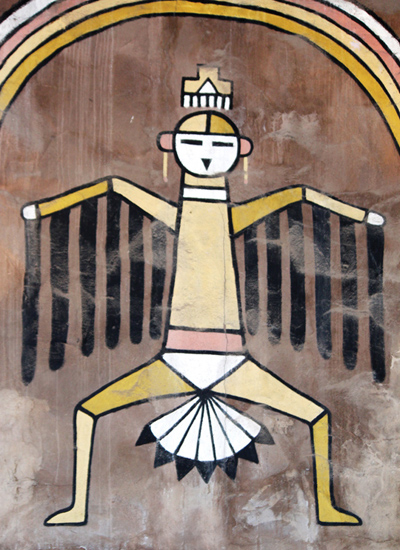
There is a painting of a crane, who evidently has swallowed several fish, since they are lined up inside his throat.  On another wall, a birdman stands with arms outstretched and feathers hanging down toward the ground.

Another bird holds something in his talons, which he is eating.

A being who seems to have a beak and large claws, leans forward, standing in front of a white moon, if it is the moon.  A white pronghorn with elegant backswept horns stands on skinny legs.

The next morning, Ray Coin, who is with Sacred Travel and Images, and is giving us a guided tour of the Hopi lands explains to us that the Hopis migrated from a large area that extended east into New Mexico, north into Colorado, and westward into the Grand Canyon.  They were not one people, but were many peoples, and the word Hopi conveys the concept of a way of life; not the name of a tribe. It could be translated as “peaceful”.

The migrations of the Hopi people

When they could see that their way of life was in danger due to the advance of people who came from Europe and then moved across the American continent, the groups who were to become the Hopis came together on the rocky, barren mesas that now make up the Hopi reservation.  The land is dry and not great for farming, though Hopi farmers today eke out a living with dry farming by knowing what crops will grow and how to plant them on the desert land.  In any case, this was land no one else wanted, for the most part, and they were left more or less in peace to live there.  It is surrounded by the Navajo reservation, and there have been occasional land disputes among the two tribes.

The Hopis believe that they were among the first people to travel across the Bering Strait, the 53 mile wide gap between Russia and Alaska, over which many of the Native American peoples are believed to have crossed at the time when it was dry land, during the last Ice Age, when glaciers locked up part of the world’s oceans.

The Hopis say that they traveled the length of the Americas going south into South America, and they look to the Aztecs as being among their forbears.  One legend recounts that when the Aztecs were constructing their temples, monuments, and great cities, some of the workmen had a falling out with their bosses, and they left, heading north, to look for a land where they’d be free from mistreatment.

Hopi clans

Ray Coin has taken an informal survey of the number of Hopi clans and has found that there are 35 separate Hopi clans.  He stresses that not everyone has the same legends and stories, and there may be various perspectives on the history of the Hopis.

In the Hopi ceremonies, the different clans have various roles, and this maintains a society of harmony and good will,  where everyone has a part to play.  The society is matrilineal, and the children inherit property from the mother’s side of the family.  A child belongs to the clan of the mother, not the father.  And a child’s uncle, the mother’s brother, plays an important role in raising the child and imparting values.

The Hopi villages of Walpi and Oraibi, on the First and Third Mesas, go back to around 900 AD and are the longest continuously inhabited towns in North America.

However, the original picturesque homes are no longer there, having been supplanted by modern-day, framed houses. The people have few resources, and unemployment among the Hopis stands at around 35%.

A drive through the Hopi reservation along Route 264 is fascinating since the dry, remote countryside has a captivating desert beauty all its own, but a traveler will see nothing of Hopi life and culture without a Hopi guide.  Villages and other sites are closed except to guided tours.

Hopi guided tours

A Hopi tour guide is the only genuine way to access any of the Hopis’ rich and profound cultural heritage.  Their artwork is stunningly beautiful, and there are many contemporary Hopi artists doing beautiful work; weavers, painters, sculptors, and craftspeople.

Photos and even note-taking in the villages are not allowed, and the people, though welcoming, tend to be private and reserved about their culture, especially their spiritual traditions.  This is entirely understandable, since, sadly, a long trail of both well-meaning and not-at-all-well-meaning writers, anthropologists, and archeologists have popularized the Hopi culture, sometimes ridiculing the sacred beings, making fun of the religion, and distorting the meaning of truths they did not understand.

Many thousands of intriguing petroglyphs adorn rock walls on Hopi lands, but you will not find them on a map.  You can see them only accompanied by a qualified guide, and they are well worth seeing.

The Moenkopi Legacy Inn in Tuba City is a lovely hotel.  The Hopi Cultural Center, with its Museum, near the Second Mesa is well worth a visit.  The links below give the contact information to arrange a guided tour.

Interestingly, as Ray Coin, explained to us, one of the Hopi principles, is not to be first – not to strive to be the most excellent, the most outstanding, or the best in a given field – but instead to work together in harmony with others – to move forward together.

These people who make do with so little, who cling like a desert wildflower to their ancient cliffs, and who invoke with beautiful artwork the spirits who live in mystical, cosmic realms that we have long ago lost touch with, have another way of seeing things, rather like the way the wind itself might see things as it blows across the dry mesas.

For more information about Sacred Travel and Images, or to contact Ray Coin, click here.

A note of caution: Some Hopi ceremonies are open to the public. If the well-being of animals is important to you, you’ll want to ask if any animals or birds are to be used in a ceremony before you arrange to attend one.

Photos: Sharon St. Joan / These are paintings on the walls of the Desert  View Watchtower at the Grand Canyon.