Katherine Routledge who lived for a while on Easter Island in 1919 recorded legends told to her by an old woman who said that the huge stone heads were moved into place by a magical technology called “mana” — an interesting word since the ancient Hebrews during their forty days in the wilderness were fed by “mana” that fell from heaven.
Twenty-five texts called rongorongo were found on the island. They contain an ancient script, which predates inscriptions made by the most recent inhabitants of the island. They were created by an earlier people, and are believed to be a form of writing, as yet undeciphered.
On stones at the tops of cliffs overhanging the ocean are petroglyphs — figures of birdmen carved into the rock. Their big beaks and big eyes are easy to make out. The name of their chief god was Makemake, who had created human beings and who had a link with the birdmen. The carved birdmen look as if they’re about to fly out over the cliff. They are a recurring theme in many cultures – a great many – like angels with wings.
In Sanatana Dharma (or Hinduism), the vehicle of Lord Vishnu is Garuda, who is a mighty, very wise being, part man and part eagle or kite, who carries Vishnu wherever he wishes to travel.
The birdmen are more recent than the great standing statues, the moai, and the birdmen petroglyphs are said to have appeared first around 1570 and to be essentially the same as some found in Hawaii, so the concept must have traveled from one island to another.
Petroglyphs also depict sea turtles and fish.
On Easter Sunday, 1722, the first European, Dutch captain Jacob Roggeveen, arrived on the south Pacific island. He stayed for a week or so. Due to a “misunderstanding”, he shot some of the island’s residents. Things went from bad to worse over the next couple of centuries with nearly all of the thousands of the islands’ inhabitants being killed or sold into slavery. Such are the hazards of being “discovered.”
In recent years the population has increased again to around 4,000, with about 60% of these being Rapanui, the native island people.
The giant stone figures, the moai, were in centuries past used during ceremonies. They stand with their backs to the sea. They were given eyes to wear during ceremonies, with the whites made of coral and the iris made of obsidian or red scoria, a type of volcanic rock filled with many holes.
The moai consist of heads along with their torsos. Only in one case was there a line of moai facing the sea. Radiocarbon dating has yielded a date of between 1100 and 1680 CE for when they were carved. In 2011 though, a large moai was dug up out of the ground, which indicates that they are both larger and older than previously believed.
They carry even today an extraordinary presence.
Thanks to the History Channel H2, which featured Easter Island in a recent program on April 8, 2012 and to Wikipedia for much of this information.
In a resounding victory for the animals, the Bombay High Court has directed the State Government to end all bullock cart races in Maharashtra, the Sakaal Times reports in a March 18, 2012, article by Prasad Joshi, “Bullock Cart races brought to halt.”
This victory is the result of the determined efforts of a number of animal groups and individuals, going back over many years. The suit was brought by Gargi Gogai, a Mumbai animal advocate. Among many others who played a key role were Anil Kataria, President of the SPCA, Ahmednagar, as well as animal activists Ajay Marathe, and Manoj Oswal.
The Animal Welfare Board of India and senior advocate, Anjali Sharma, laid out the case for the animals with a letter to the authorities.
The judge’s recent ruling requires district officials and the police to enforce the ban on all bullock cart races in Maharashtra.
Despite thousands of years of revering the cow and the bull as sacred animals, and despite the reverence that most Indians today feel towards these animals, some public events have continued to be held which are distinctly cruel. One of these has been bullock cart racing, in which the bulls pull a cart, racing along in the heat of the day.
Animal races, like any animal-related sport, are never kind. There are unseen cruelties, hidden from public view. A quick look at any of several videos posted on Youtube of bullock cart races will show clearly that the animals are pushed and pulled this way and that and treated very roughly by their handlers.
But on top of this rough treatment, the bulls are also being tortured in ways hidden from the camera.
Bulls will not naturally run, they are not greyhounds or horses, they’re laid-back animals who really like standing around in fields, so to make them run, they must be made to feel pain by a variety of means. This is an extremely cruel sport, in which the animals suffer by being tormented.
After many years of hard work by animal advocates to have these races banned, there seems to be a light shining at the end of the tunnel.
Recently rescued bulls at Blue Cross.
Last summer saw a milestone reached with the landmark issuing of the Notification by the Ministry of the Environment and Forests on July 11, 2011, banning leopards, tigers, lions, bears, monkeys, and bulls, as performing animals.
However, everything then took a step backwards on September 11, 2011, when the Maharashtra State Government announced that actually the ban did not mean all bulls, and that neutered, castrated bulls weren’t really bulls and could still be used in races.
The Animal Welfare Board of India, on the other hand, endorsed the broad, inclusive meaning of “bulls” as designating all bulls, both neutered and non-neutered, maintaining that Bullock cart racing is entirely illegal.
The latest ruling, by the Bombay High Court, has cast aside the faulty distinction between neutered and non-neutered bulls.
The Bombay High court, in their decision signed by Chief Justice Ranjit More, J., has ruled that in fact all bulls really are bulls, whether neutered or not, and that the court order bans all bullock cart races, games, exhibits, and training of bulls. No bulls can be used as performing animals. Any bull owner who allows his bull to race in a bullock cart race is in violation of the provisions of the Animal Protection Act, 1960. The Court also requested that the State of Maharashtra increase the penalty, calling the current fine “miniscule,” so this is a major victory for the bulls. It definitively outlaws bullock cart racing in the State of Maharashtra and sets a precedent for similar events in the rest of India.
Rescued bulls.
This major ruling in Mumbai follows an earlier ban of bullock cart races in the State of Punjab.
Kila Raipur, in Punjab, is a well-known village where the three-day Rural Olympics take place every year. They include contests and tests of strength. Unfortunately, they have also included bullock cart racing.
This year though, the bullock court races were stopped in Punjab. Early in February 2012 as the Rural Olympics were about to get underway in Kila Raipur, the state authorities, pursuant to last year’s Notification banning bulls and five other species from being used as performing animals, halted the races, not allowing them to go forward.
A letter from the Animal Welfare Board of India was taken to Punjab to the Haryana High Court, Chandigarh, a day before the games were to start.
The Court then ordered the District Magistrate Ludhiana to issue a decision. Having reviewed the AWBI letter, the Government Notification banning use of bulls as performing animals, and the Expert Opinion of the Animal Husbandry Department, the District Magistrate ruled that bullock cart races are illegal, and so the case in Punjab was settled out of court.
On April 23, 2012, the Madurai bench, in Tamil Nadu, will hear the jallikattu case, and it is hoped that the bullock racing case will serve as a precedent. (Jalikattu is another cruel sport, in which bulls are pursued and tormented by crowds of young men.)
Years of work and perseverance on the part of the Indian animal movement are at last paying off, and the bulls are being freed from the suffering inherent in these kinds of brutal sports.
To view the March 18, 2012 Sakaal Times by Prasad Joshi, “Bullock Cart races brought to halt,” click here.
To visit the website of the Animal Welfare Board of India, click here.
Photos: Sharon St Joan / These particular bulls were not used in bullock cart races. They were recently rescued from illegal transport by Blue Cross of India.
Kanchipuram, which is one of the oldest cities in India, is over 2,000 years old, has been called the city of 1,000 temples. In the third century BCE, Ashoka built a stupa here. It was visited by Chinese travelers in search of Sanskrit texts on Buddhism and was the home of Bodhidharma who took Buddhism to China. The city lies 83 kilometers (52 miles) southwest of Chennai (Madras).
Normally Indian temples face east, but at Kanchipuram, all the temples face towards the temple of Kamakshi, who was the original Village Goddess of Kanchipuram. Kanchi was named after the kanchi tree.
In fact, there are two temples of Kamakshi. There is the current temple, the main temple where people worship today, and there is another temple called Adi Kamakshi (or the first Kamakshi), where the original deity, the first Kamakshi, stands. She was originally called Adi-peetha-vasini or the “original inhabitant of the seat” (or, the place).
This is because Kamakshi has undergone a couple of complete transformations in her over-two-thousand-year-old history.
In the very beginning, like every village Goddess in India, she was a representation of the universal Mother Goddess, the source of all life in the universe, and, on a local level, the one who protected all those who lived in the village – the kind mother figure, who could solve all problems and to whom one could pray, expecting a response of kindness and love. This was the Goddess in early Neolithic times.
Then something changed. Along came farming, and at some point the concept of owning individual land. Life was no longer quite so simple as it had been before. If a person owned land, then he must protect it, and this set the stage for conflicts and eventually wars. Land could also be inherited, meaning that the husband must be able to identify clearly who his true heirs were.
A subtle change began to take place, and the way Kamakshi came to be viewed reflected that change.
The female over time slipped into a subservient role. With the male now at the top of the social structure, it was no longer really convenient to have the Goddess figure revered and worshipped as an entirely good, divine being. Surely the female must be shown to have a less than divine, or even a frightening side, musn’t she?
With the female taking a secondary role, the local female Goddess also took on a different role – no longer seen as entirely benevolent, but often shown with a ferocious streak.
While the village Goddesses took a turn towards ferocity, the same thing did not happen to the primary Hindu Goddesses, who remained as powerful and beneficent as ever.
After all, Hinduism is the only major world religion which retains the worship of the Goddess as a central element; she is still worshipped, loved, and revered as the giver of all life.
However, the local village Goddesses, in general, did not fare quite so well – they underwent a change in perception – and even now, there are some local Goddesses who are perceived as fierce.
The Kamakshi Temple gopuram or temple gate
The transition can be seen in the stone statue of the original Adi Kamakshi, who is no longer the focus of worship, but who is instead standing in her own temple, apart from the main temple – set aside, out of the way. This original Adi Kamakshi stands, a stone figure in a niche. Dr. Nanditha Krishna, a leading authority on Indian iconography, says that she is most likely at least 2,000 years old.
She seems, to me anyway, to have a very sweet face – not sweet in a light, fluffy sense, she seems much too connected to the earth for lightness and fluffiness, but in a real sense, she does seem sweet—genuinely kind and compassionate. Or perhaps I am only imagining this benevolent aspect. Looking more closely, one can see that she holds a stone severed head, and there seem to be stone sacrificial victims under her feet. So maybe the sweetness and kindness are just an illusion or wishful thinking?
Yet, all the same, her face does portray a feeling of sweetness and kindness. She doesn’t smile, but there is kindness there, nonetheless—and no sense of malevolence.
Could this be the stone image of the Goddess caught right at the moment when the original kind, beneficent mother figure is giving way to the ferocious one, who must be propitiated? This ferocious form still lives in India today, for example, in the figure of Kali, who is shown wearing a necklace of skulls, who is feared, and regarded as blood-thirsty.
Kamakshi, who was at that time known by another name, did indeed develop a reputation for ferocity. Who knows how long this phase lasted – maybe 500 years, maybe a thousand, maybe longer.
This is not the end of the story for Kamakshi, however, but only the midpoint.
Thanks to one of the most remarkable figures in all of Indian history, Adi Shankara, who lived (probably) in the seventh century AD, Kamakshi was transformed once again into a beautiful, kind Goddess. Her name, Kamakshi, means “eyes of love,” and this is the name that Adi Shankara gave her.
Painting of Adi Shankara by Raja Ravi Varma
Traveling on foot all over India, with his loyal followers, Adi Shankara was a healer, a teacher, and a saint, who revived Sanatana Dharma (the Eternal Truth, which is the more correct name for Hinduism). At the young age of 32, he died, having traversed hundreds of miles, having written over one hundred books, and having set up structures called maths, which still exist, which are centers that faithfully continue to carry out his mission of maintaining the unity, harmony, coherence, and the spiritual integrity of the faith of India.
In the main Kamakshi temple, there is a large section devoted to honoring Adi Shankara, and all the succeeding Shankaracharyas; appropriately, since it was he who brought back into view Kamakshi’s true gentle nature.
While in Kanchipuram, Adi Shankar taught the people that the Goddess Kamakshi was in no way ferocious or to be feared. Seeing her as fierce, he stated, had been a mistake. On the contrary, he affirmed that she was the Goddess with “eyes of love.” She is considered a form of the Goddess Parvati, the consort of Shiva. Also, she may be seen as a form of Durga, who fights and conquers evil. As he traveled throughout India, Adi Shankara restored, in the towns and cities he passed through, the ancient view of the Goddess as kind and compassionate.
He unified a multiplicity of divergent belief systems and philosophies that had cropped up over the centuries. By the mere strength of his presence, he turned people away from the path of divisiveness and corruption. Almost single-handedly, along with his followers, turning back the trend society had taken towards the alternate paths of Buddhism and Jainism, Adi Shankara led India back to Sanatana Dharma, restoring faith in the age-old Vedic and Upanishadic traditions, and even incorporating some tenets of Buddhism when they helped with this process. He brought unity, stability, and continuity to that which had become fragmented. Not a political or a military leader, he nonetheless united India in a very real, enduring way.
Today, Kamakshi’s stone statue stands in the main, newer temple (“new” meaning built mostly in the fourteenth century, though some sections are older), her gentle face enveloped in garlands of flowers, surrounded by the bright glow of fires and the fragrance of incense, where, having come full circle, she is worshipped by throngs of those devoted to her, as the Goddess of kindness and love.
Thanks to Dr. Nanditha Krishna, who provided the knowledge and information for much of this article, but who is not responsible for any inaccuracies that may have crept in.
Top photo: Sharon St Joan / the Kamakshi Temple tank (2010)
Second photo / Sharon St Joan / the Kamakshi Temple gopuram (2010)
Third photo / Wikimedia Commons / Public Domain / painting of Adi Shankara by Raja Ravi Varma
Praveen Raj spotted the Intermediate Egret above at the Lake Pulicat Bird Sanctuary, near Tada. The largest brackish lake or lagoon in India, it straddles the Andhra Pradesh/Tamil Nadu border. The Pulicat Lake Bird Lovers Society is one of the organizations working to promote environmental awareness and protection for the lake which is under threat from the run-off from farms and factories.
Egrets and herons are very closely related and belong to the same family. Egrets are generally white, often with black feet and legs and yellow bills, while herons exhibit a greater variety of colors. Herons seek higher perches, and egrets prefer to stand in shallow water.
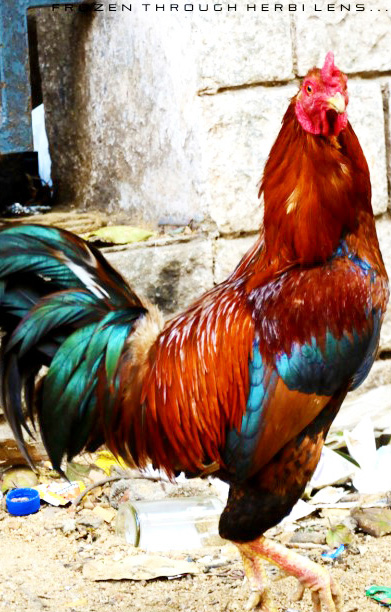
The pigeons and the third egret above were seen in Chennai, as was the rooster.
To learn more about the lake on a website put up by the Pulicat Lake Bird Lovers Society, click here.
To view more photos on Praveen Raj’s Facebook page, click here.
Photos: Courtesy of Praveen Raj, frozen through herbi lens
Hit by a vehicle, the two-month old baby donkey was thrown clear of the Eastern Express Highway, near Vikhroli, one of the suburbs of Mumbai. His rescuers picked him up quite a distance away from the highway.
When he was brought in to Thane SPCA, his most immediate problem was severe loss of blood. It took a while to stabilize him, and by that time gangrene had set in, further threatening his life.
To save the little donkey’s life, he needed an operation to remove his leg. But this was a big problem. A dog will do fine with three legs, but a big heavy animal like a donkey (and a little donkey will of course grow into a big donkey) doesn’t do so well with three legs.
They asked a number vets to perform the operation, but all felt hesitant; they had no experience with amputating the leg of a donkey, and they felt doubtful about the outcome. Then, Thane SPCA’s regular surgeon, Dr. Vikaram Dave, agreed to do the surgery. He studied the case extensively, and he began calling the donkey “Dear” – a name which stuck with the charming little fellow because of his lovely nature.
Dr. Dave performed a three-hour operation on Dear.
Because Thane SPCA doesn’t have a chain and pulley system with which to suspend large animals (the cost is prohibitive), they rigged a sling to the roof of the cattle shed, to keep Dear suspended until his wounds had started to heal.
Soon he was back on the ground and active again. His leg was dressed every day by the vets, and twice a week by Dr. Dave. Being an active little donkey, he wouldn’t stay still and managed to move around more than was good for him, so the wound tended to open up. Dr. Dave designed custom socks for him to keep this from happening.
Dear was given a supervised walk every day to keep his metabolism in good shape. He didn’t seem to notice that he had a missing leg and was super-friendly with all the other shelter residents.
Thane SPCA’s friend, Dipankar, a IIT engineer, put his engineering skills to work to design a special artificial leg for Dear, and it was fitted on him. After initial awkwardness for the first couple of days, Dear grew used to it and does fine with it.
He has it on the whole day, and it’s taken off at about 8 pm when he gets ready to sleep.
This artificial leg is just the prototype. Dipankar is still perfecting the design, and at least five changes will be incorporated in the final design. Dear is very acclimated to wearing his new leg, and should be really comfortable with the final version.
There have already been a number of inquiries from people who own farms about adopting Dear, to give him a lifelong, happy home.
It is hoped that this success with Dear will set a precedent for developing prosthetic legs for other donkeys and horses who need them, when their circumstances will allow them to live out their lives in an adoptive home.
Quite a lot can be done to help working animals. Rosalind Rengarajan’s insights into human nature have changed many of these magnificent animals’ lives for the better and her service to them could well be a template that everyone can use to educate the public about animal welfare.
When senior citizens Rose and her husband Rengarajan started Sheba Vet Clinic in 2000 at Chennai, with the help of a donor who chose to stay anonymous, their goal was simple: provide free and high-quality medical care to animals whose owners could not afford private veterinary care. As the years went by, hundreds of people who lived on the edge of poverty brought their animals to Rose’s clinic where veterinarians administered life-saving drugs, pain-killers and dispensed advice on how to care for the animal. It was not uncommon to see a long queue of animals outside their St. Thomas Mount establishment. Rose’s vets are always at hand, sourcing medicines, diagnosing illnesses and saving those that are fortunate enough to be brought in on time.
As word spread, the number of Rose’s beneficiaries increased, and with this development came another welcome opportunity: a chance to talk to owners about treating their animals right. The medicine people as they were popularly known, found that providing veterinary treatment for a wound for instance, increases the owner’s empathy for the animal’s pain and makes them reconsider physical abuse. She has gently advised bullock cart owners to refrain from whipping or overloading their beasts, and to return to her clinic for free treatment whenever the animal needed it. She is optimistic that there has been a change in attitude amongst her human visitors and it is this accomplishment that motivates her to continue operating the clinic despite the mammoth challenges that were thrown her way.
When donor funds ran out in 2009, Sheba Vet Clinic appealed for funds and the media covered their good work as well. However, the clinic had to shut shop when donations failed to cover operating costs. Rose’s husband Rengarajan had a stroke very soon after this, and passed away a few days later while in intensive care. Rose was now at the crossroads. Despite her grief and lack of resources, she reopened Sheba Vet Clinic on a smaller scale and reached out to the animals that needed her desperately. Tamil Nadu has no government veterinary hospital that can provide medical care for animals belonging to underprivileged people and Rose felt that the clinic was the only way to make a lasting difference in the voiceless workers’ lives.
She continues to feel a sense of deep satisfaction every time a bullock with gentle eyes is relieved of his pain and is led away by an owner who has had a change of heart. She remains a blessing to distraught pet-owners who don’t have the money for a taxi to the vet, let alone medication or surgery. Rosalind has always set aside her own pain and focused on that of others. As for the lucky four-legged ones who find themselves at her door, they have arrived at the one place where they can ask for help and will not be turned away.
Renrose Animal Care Trust is a registered charity with Sec 80(g) tax exemption. To contribute to the running of the clinic, contact Rosalind Rengarajan at renrose@yahoo.co.in
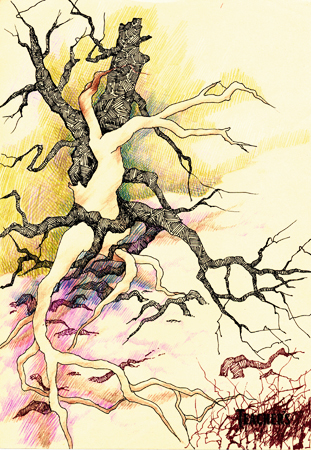
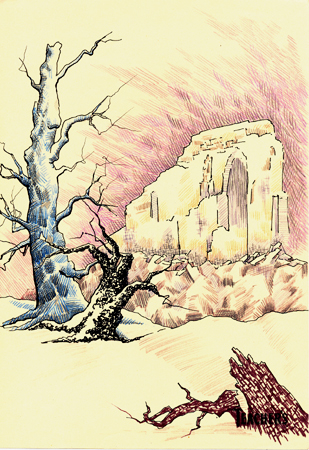
“Vriksha” means “tree.” S. Shankar’s remarkable paintings invite us to see trees and all of the environment as living, sentient beings to be valued and protected.
S. Shankar lives in Kolkata, India, and recently held the exhibit, “Vriksha – a Saga of trees” at the C. P. Art Centre, in Chennai.