The Golden Scarab Beetle

Scarab beetle

In the book “Jung’s Map of the Soul, An Introduction”, Murray Stein recounts the story of an incident that happened with a patient of Jung’s.  The patient had a dream of a golden scarab beetle.  As they were discussing this, they became aware of a sound outside the window, and when they looked, there was a Swiss version of the same kind of beetle (Cetonia aurate) trying to get into the room.

Referred to as synchronicity, these sorts of events in which an occurrence in the outside world and an occurrence in the inner world mirror each other, have happened to many of us.  Sometimes we see them as profoundly meaningful, sometimes we dismiss them as coincidence, sometimes they go unnoticed.

Occurrences like this should come as no surprise to anyone with a knowledge of the Hindu concept that the innermost soul of every being, the atman, “the self”  (which is the opposite, generally speaking, of what we in the west consider to be the “self”) is identical to the universal Brahman—who is the great, underlying soul of the universe.  (I’m expressing this in my own terms—and there are many, varying schools of philosophy in Hinduism, but this is a primary, and widely accepted thread, that runs throughout Hindu thought.)

One may question whether there is a clear division between the inner world and the outer world.  Is there an inner and outer at all?  This question flies in the face, not only of the material, atheistic view of the physical world as a sort of stand-alone event, that props itself up with its own laws of physics and has it’s own discrete, independent, unchallengable existence, but it also is quite different from the day-to-day perception that we, to the extent that we subscribe to a modern, western headspace tend to have of the world around us.  As modern people, for us, things happen from external causes; events are required to follow the rules laid down by Newtonian physics and, for most of our lives on most days, that is that.  The thunderstorm occurs, not because the gods are angry, but because the air currents and humidity are acting in a certain physical way.

Yet even modern physics has overturned this prosaic worldview, decades ago, with quantum physics and other even more arcane theories and concepts.  Certainly, going back in time, for most of the societies that have gone before us, the inner world and the outer world are not two distinct happenings.  They are intertwined—and life is, or can be, magical, mystical, pervaded with spirits, with numinous presences, with events and atmospheres far more meaningful and profound than the prosaic constructs we have deluded ourselves into seeing as “reality”.  The “primitive”, animistic view of tribal people that knows the world as one filled with consciousness—where every stone, river, bird, or mountain is filled with life and awareness may be closer to the truth than our own sophisticated, but destitute, perception of reality.

“Reality” is far grander than anything we might imagine, and God and the gods more real than we might ever have thought possible.  The underlying mystical reality of time and eternity far more present and profound than our own carefully-trained blindness has allowed us to see.

Photo: Wikimedia Commons /  A scarab beetle, for the occasion of the marriage between Amunhotep III and his wife, Queen Tiye 

Sittanavasal and the invasive onion

A view of Sittanavasal

At the Sittanavasal site there is a sacred grove, one of over 50 sacred groves restored by CPREEC (C.P. Ramaswami Environmental Education Centre) in the past few years.

Dr. Nanditha Krishna, Honorary Director of CPREEC, who was instrumental in restoring this grove, as well as the others, recalls that when CPREEC first arrived in the mid-nineties to have a look at the Sittanavasal site, the area surrounding the great rock was a barren spot where nothing grew.  Over the centuries all the trees and other vegetation had been destroyed; land once sacred had fallen into disrepair and been forgotten.

The CPREEC program to restore the sacred groves in southern India has several interrelated purposes—a major goal is to protect the environment and the natural wilderness of India, by maintaining the groves that still exist and by restoring those that have been destroyed.

As is the case for the rest of the world,  forests and wilderness areas in India have been under assault, especially the last couple of centuries.  Farming has taken its toll, as have industrial development, economic development, and the tourist industry.  On land once called sacred, one may find anything from city blocks, to heaps of trash, to a factory, a shopping center or a hotel; sometimes one finds nothing at all—just an empty stretch of land with no trees or plants. In a surprising number of cases though, the village people have preserved their sacred groves and have not allowed their destruction.  It is the reverence for the land as a sacred place that serves as an incentive for the people living there to restore the natural environment.  For all the thousands of villages in India, each one once had a sacred grove.

Dr. Nanditha Krishna

CPREEC works together with the village people in each location.  They will assume responsibility for restoring the sacred grove, and in exchange the people there will agree to maintain it, not allowing it to fall into disrepair again.  This also means not allowing it to be used in ways that will harm the native plants and the habitat of the animals living there.  Everything that is a part of nature will be preserved and protected.  The accepted guidelines for each grove may differ.  In some groves, dry branches may be collected to use as firewood; in other groves, even this is prohibited.

At the foot of the great rock of Sittanavasal, nothing was growing by the 1990’s but grass.  There were no trees, vines, or flowering plants. It was a wasteland.  The professional people of CPREEC—botanists and environmental experts arrived.  They did extensive interviews with the village elders and researched the local area to determine exactly which plants were native to that particular location.  After all, there wouldn’t be much point in planting species that didn’t belong there.  Only original native species would be used to restore the sacred grove.

Very shortly they came across an unexpected difficulty.  Something was wrong with the soil.  It was strangely acidic, and they eventually came to the realization that this was a human-caused problem, but, amazingly, not a recent one.  Around 1,500 to 2,000 years ago, when the Jains lived there, as they were painting their incredibly beautiful frescoes on the walls, they were extremely careful, as always, never to harm any animals.

Sittanavasal - another view

The binding material in many types of paint was made from animal products.  This was not at all acceptable to the Jains, since they believed in doing no harm to any animals. So they had to develop paints that contained only plant-based products.  They achieved this by using an ingredient found in a particular species of onion, and subsequently, they planted lots and lots of these onions nearby in the ground, so that they would have the wherewithal to continue to manufacture their paints.

In saving the animals from exploitation, however, they unwittingly were harming the local soil.  Of course, they had no way to know that this was happening, and it was an ironic turn of events that the Jains, in protecting nature, were accidentally and unknowingly causing harm to the environment.

Once they realized that the invasive onion species was the cause of the imbalance in the soil, CPREEC spent countless hours removing the onions from the ground (they were still growing there 2,000 years later!) so that other plants would be able to grow again.  They got up nearly all of them, the soil became fertile again, and they were able to plant trees, flowing bushes, and vines—that have since grown into beautiful plants.

While we were visiting this past February, we did come upon an unexpected occurrence, a little onion remained right there in the ground.

Whenever CPREEC restores a sacred grove, they hire one of the people living there to serve as the grove’s custodian.  Rangam, the custodian of the Sittanavasal sacred grove, had accompanied us, up the steep stairway cut into the rock, so that we could see the ancient windswept site at the top—and then at the foot of the great rock, he led us along the pathway through the restored sacred grove, now lush with trees and plants which lend great beauty to the majestic rock.

Rangam, with the onion

Then Rangam came across the stray onion—right there at his feet growing in the soil.  He carefully dug it out of the ground and held it up—the offending alien onion.

(Although it is silly, I did feel a little sorry for the onion.  It will no doubt become a happy onion in heaven.)

How hard it is as humans to avoid causing harm to the earth. Even the ancient Jains, who managed far better than most of us do, could not avoid harming a bit of the planet, even as they were doing their best to protect the animals and the natural world.

By the wave of the waters


Barn Owl

Across the shambled ruins

Of empire,

The wild winds

Of innocence

Shift the sands

Of bitter bones

And the fragments

Of forgotten footprints.

There by the wave

Of the waters of the great

Sea, the barn owl,

Who, of yore,

Invoked

The falling

Stars, flits in moth-dreamed

Elegance

From cliff to cave

In the silvered night

Where the stands

Of singing pines

Await

The bright

Rising

Of the moon, whose cowl

Of fire

Gleamed

In the time before

Time,

From the mist-cloaked

Hill of haunting

Stones.


Written around 2004

Photo: Steve Allen / Dreamstime.com


A comment on the Lascaux Caves

A horse in the Lascaux Caves

There is a reason that in the cave art of southern France, and in many spiritual traditions, including ancient Egypt, there are part human, part animal figures depicted—it is because they really are neither human nor animal, they are gods, archetypal beings.  They are entities that have a consciousness that belongs to a more profound level of reality—the magical level.  Though animals are innocent, unlike humans, and that sets them apart from humans, still animals are not necessarily, in and of themselves, magical beings.  They are magical beings only when they have an unbroken connection with the magical realms, on a level beyond the world, with the mystical beings that live there and belong there.  Otherwise, they are innocent beings caught in the net of the physical world.

Photo: Wikimedia Commons public domain

Sittanavasal

Millions of years in the past, at the site where Sittanavasal is now, in the Pudukottai district of Tamil Nadu in southern India, a mountainous rock emerged over time out of the earth. It still stands there today, and at some point thousands of years ago, Jain monks went on a steep climb up to the top of the solid rock extending hundreds of feet high, and, with only a narrow path to follow along the ledge on the far side of the rock; there they made their way to a low-ceilinged natural cave, known as Eladipattam. In the cave they carved out seventeen stone beds and stone pillows, where the monks slept, and no doubt they spent long days and hours in meditation in this remote, mystical place high above the universe, where only the wind travels.

One of these stone beds contains a text in the Brahmi script, in the Tamil language, which may date back to either the first century BC or, as the sign says, to the second or third century BC.  Other Tamil inscriptions are from later on around the eighth century AD. Unfortunately, there is also a lot of modern graffiti.

It’s not certain how long Jain monks remained in this spot—at least until around the ninth century AD, since a nearby Jain rock-cut temple contains frescoes from that period.

The temple, Arivar-Koil is very small, with just two rooms; in one room are three life-sized sculptures of Jain saints. The one to the left is Parsvanatha, the 23rd Thirtankara, and across from him sits a Jain teacher. The third figure is thought to be another Thirtankara. Jain beliefs are complicated; the Thirtankaras are neither gods nor humans, but they are enlightened beings.  Jains are known for their particularly strict adherence to the teaching of ahimsa, or non-violence, which is common to all the spiritual traditions originating in India.

Several million Jains live in India today; however, they now represent less than one percent of the population.  In earlier centuries, following the first century AD, both Buddhism and Jainism held sway on the Indian subcontinent.  After that time Hinduism gradually regained its position as the predominant religion of India, and Buddhism especially took hold throughout the rest of Asia.  As a general rule though, there has been neither violence or animosity among the various spiritual traditions native to India, and, for the most part, they have co-existed with mutual respect and the recognition that they hold similar value systems.

The innermost room of the Arivar-Koil temple contains in the ceiling  a circular feature, and the room itself is an echo chamber.  Our guide, who knew yoga breathing techniques, was able, by breathing completely silently, to cause the entire room to be filled with a very loud sound of the syllable, Om.  No one else there could produce this effect although the rest of us tried.  We could, by uttering out loud the sound Om observe that the sound grew louder and louder as it reverberated in the room.  But only the guide could produce the remarkable effect of his silent breathing producing a loud audible sound, amplified through the circular feature in the ceiling.  So much for the principles of science that lay down the laws of physics, of what can be true and what can’t, since clearly physical laws do not allow sound to come from nowhere—but a loud sound did indeed spring out of the silence of the temple.

I was reminded of one of the tombs at Sakkara, in Egypt, where there is a room also cut out of a single solid stone, no larger than eight feet by ten feet, where when one made a sound, the room picked up the sound and echoed it in a remarkable way.  One is reminded also of the myths of ancient Britain, where it is said that Merlin transported giant standing stones by sound alone—and even that there are standing stones, among the 10,000 stone circles scattered throughout the British Isles and Brittany, that have the power to move by themselves in the night—who knows, perhaps they do.

In the temple at Sittanavasal, there are also frescoes, beautiful works of art, some are identical to those found in the Brihadeswara Temple in Trichy not too far away.

The paintings on the walls are remarkable, done with great sensitivity and artistic skill. The central painting is of a pond with lotuses that are being picked by monks, fish, animals, and by the ducks and swans that live in the lake.  Other paintings also feature flowers and plants.

Sittanavasal carries to this day a sense of peace and the presence of the otherworldliness of the ancient Jains who led lives of self-sacrifice and devotion.


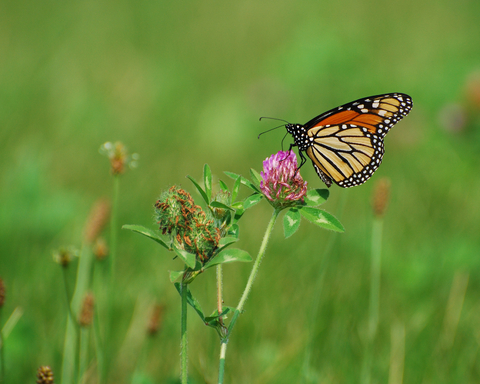
The Butterfly

Brave-winged, in orange-rose

Attire, the small,

Bright butterfly,

Climbs the pale stairway

Of the sky.

Her eye,

A shining hall

Of mirrored scenes, on she goes,

Intent on following

Her pathway,

Through earthlight, through deep dragonshadows,

Through rains, snows

And the valleys of the sun,

Glad to glimpse the white mountain

Through the green hills of morning,

Glad to hear the far call

Of the wild geese

Unlatch the gate of evening,

And glad to be

At one with the cosmic butterfly

Who sheds her peace

On all,

And soars in beauty

Across the song-lit steppes of being.

Written around 2002

Photo: Larry Keller / Dreamstime.com